Technologies 08.09.2026
08.09.2026 SpeedyGo: One plugin to make your WordPress website faster
 Corvexa: AI that turn more website visitors into qualified leads.

 Energy
 Oil and gas
 Transportation
 E-commerce
 Healthcare
 Real Estate
 Fintech
 Manufacturing
 Education
 Agriculture
 Travel
 Cyber Security
 Crypto
 Law and Order
 Entertainment
 Hospitality
 Logistics
 Non-profit
 Digital Industry
 Venture Capital
A Quick Guide on the Right Software Development Approach for Enterprises in 2023

 08/09/2026


Building a new application is exciting, but it can also be risky. A great idea on paper does not always translate into a great product. Users may find the interface confusing, important features may not work as expected, or the development team may discover technical problems after significant time and money have already been invested.
This is where rapid app prototyping can make a major difference.
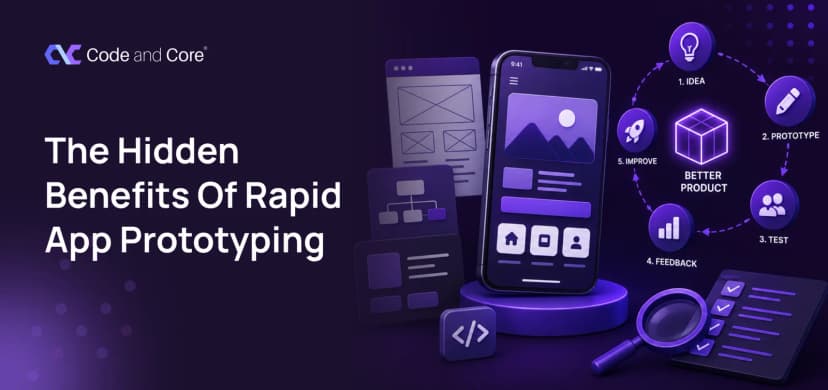
A prototype gives teams an early version of an application that demonstrates how the product could look and work before full development begins. It allows businesses, designers, developers, and stakeholders to test ideas, identify problems, and make better decisions early in the process.
For businesses investing in custom application development, rapid prototyping can help reduce uncertainty and create a clearer path from an initial idea to a functional product.

What Is Rapid App Prototyping?
Rapid app prototyping is the process of creating an early model of an application quickly. Depending on the project, a prototype can range from simple wireframes to an interactive version that closely resembles the final application.
The purpose is not to build the complete product immediately. Instead, the prototype helps answer important questions:
By answering these questions early, teams can make informed decisions before full-scale development starts.

It Helps Turn Ideas Into Something Real
One of the biggest challenges in application development is explaining an idea.
A business owner may have a clear vision in their head, but developers and designers may interpret that vision differently.
A prototype turns abstract ideas into something people can actually see and interact with.
Instead of discussing how a dashboard should work, for example, stakeholders can click through the dashboard and experience the proposed workflow.
This creates a shared understanding between business teams, designers, and developers.

It Finds Problems Before Development Gets Expensive
Fixing a problem during the planning stage is usually easier than fixing it after the application has been developed.
Imagine discovering after launch that users need five steps to complete something that should take only two. Changing that workflow may require modifications to the design, frontend, backend, database, and testing process.
A prototype can reveal the problem much earlier.
Teams can test the user journey, identify unnecessary steps, and improve the experience before those decisions become expensive development changes.

It Improves User Experience
A technically functional application does not automatically provide a good user experience.
Users care about how easily they can navigate the product, find information, complete tasks, and understand what each feature does.
Rapid prototyping gives designers an opportunity to test these interactions before development is completed.
Teams can observe where users hesitate, which screens create confusion, and whether important actions are easy to find.
The result is often a cleaner and more intuitive application.

It Makes Client and Developer Communication Easier
Miscommunication can create major problems in custom application development.
A client might request a particular feature, while developers may understand the requirement differently. Written documents alone do not always provide enough context.
An interactive prototype provides a visual reference.
Everyone can see how the application is expected to work. This makes discussions more specific and reduces ambiguity.
Instead of saying, “The checkout should be simple,” stakeholders can review the actual checkout flow and discuss exactly what needs to change.

It Helps Prioritize Features
Not every feature needs to be included in the first version of an application.
Businesses often start with a long list of ideas. Some features may be essential, while others are simply nice to have.
Prototyping can help teams identify the features that provide the most value.
For example, a startup developing a booking platform may initially consider dozens of features. After reviewing the prototype, the team may realize that account creation, search, booking, payment, and notifications are the core functions.
This makes it easier to define an MVP and focus development resources on what matters most.

It Supports Faster Decision-Making
Without a prototype, teams may spend weeks discussing different possibilities.
Should the navigation be on the left or at the top? Should users complete the process on one screen or several? Which information should appear first?
Prototyping allows teams to compare options quickly.
Designers can create different versions of a screen or workflow, test them, and choose the most effective approach.
This can speed up decision-making without rushing the overall development process.

It Can Reduce Development Costs
Rapid prototyping requires an initial investment, but it can potentially reduce overall project costs.
The reason is simple: early changes are generally less expensive than late changes.
Changing a button, screen layout, or user flow in a prototype can take minutes or hours. Making the same change after development may require coding, testing, debugging, and deployment.
For businesses planning custom application development, finding problems early can help protect both the budget and timeline.

It Helps Validate Business Ideas
A prototype is not only useful for developers. It can also help businesses validate their product idea.
A company can show the prototype to potential customers, investors, partners, or internal teams and collect feedback.
This can reveal whether people understand the product and whether the proposed solution addresses a genuine need.
For startups, this can be especially valuable because it allows them to test an idea before making a major investment in full application development.

It Gives Developers Better Technical Direction
Design and development should work together from the beginning.
A prototype helps developers understand how screens connect, what interactions are required, and what functionality needs to be supported.
Developers can also identify technical challenges early.
For example, a proposed feature may require a complex API integration or real-time data processing. Identifying this during prototyping gives the team time to evaluate possible technical solutions.
This creates a more realistic development plan.

It Makes Stakeholder Feedback More Useful
Getting feedback early is valuable, but the quality of that feedback matters.
When stakeholders only see documents or static descriptions, their feedback may remain general.
An interactive prototype gives them something concrete to review.
They can experience the application from a user’s perspective and provide more specific feedback about navigation, features, content, and workflows.
This can make feedback cycles more productive and reduce unnecessary revisions later.
The word “rapid” can sometimes create the wrong impression.
The goal of rapid prototyping is not to rush through the design process. It is about learning faster.
A good prototype should focus on the most important questions and workflows rather than trying to replicate every detail of the final application.
The level of detail should depend on the project. Some ideas can be validated with simple wireframes, while complex products may require highly interactive prototypes.
Rapid prototyping can be particularly useful when:
It is not limited to startups. Established businesses can also use prototyping when launching new digital products, redesigning existing applications, or introducing new features.
Custom application development is about creating software around specific business requirements rather than forcing a business to work around a standard solution.
That makes planning particularly important.
Rapid prototyping provides a bridge between business requirements and technical development. It allows teams to understand the product from the user’s perspective before writing large amounts of code.
When combined with user research, UX design, technical planning, and iterative development, prototyping can create a more reliable foundation for the final application.
Build Better Applications With Code and Core
At Code and Core, we understand that successful application development starts long before the first line of production code is written. Our team focuses on understanding business goals, user needs, workflows, and technical requirements before moving into development.
From UI/UX design and rapid prototyping to MVP development, custom application development, API integration, testing, and ongoing support, we help businesses turn ideas into practical digital products.
Whether you are validating a new startup idea or improving an existing business process, a well-planned prototype can help you make better decisions before investing heavily in development.
Rapid app prototyping is more than a design step. It is a way to reduce uncertainty, improve communication, validate ideas, and build products around real user needs.
The biggest benefit may be what it prevents: wasted development time, unclear requirements, unnecessary features, and expensive changes late in the project.
For businesses planning custom application development, starting with a prototype can provide the clarity needed to move from an idea to a product with greater confidence.
Catch wind of the latest technologies, strategies, and information that are set to boost your business operation. We update frequently!