Development 05.10.2026
05.10.2026 SpeedyGo: One plugin to make your WordPress website faster
 Corvexa: AI that turn more website visitors into qualified leads.

 Energy
 Oil and gas
 Transportation
 E-commerce
 Healthcare
 Real Estate
 Fintech
 Manufacturing
 Education
 Agriculture
 Travel
 Cyber Security
 Crypto
 Law and Order
 Entertainment
 Hospitality
 Logistics
 Non-profit
 Digital Industry
 Venture Capital
A Quick Guide on the Right Software Development Approach for Enterprises in 2023


 05/10/2026


| Quick summary
This front-end agency hiring guide gives you one clear checklist before hiring a web development agency. You will learn how to evaluate a dev agency portfolio, which questions to ask a web development agency, and which red flags should make you walk away.
|
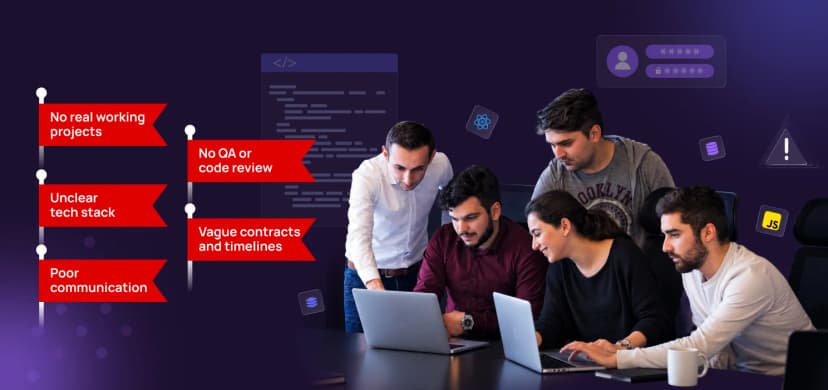
Picture this. You pay a deposit, the agency sends a nice proposal, and everything feels great. Eight weeks later, the site looks fine on their laptop but breaks on your customer’s phone. Buttons overlap. Pages crawl. Nobody answers emails fast anymore.
It is a painful story, and it is common. The good news is that almost every bad hire shows warning signs early. You need to know where to look.
This checklist for hiring a web development agency walks you through it step by step, in simple terms. No jargon and no sales pitch.
Front-end work is everything your visitor sees and taps. It covers layout, speed, mobile view, and even how easy the site is to use for people with disabilities. It is easy to fake in a demo and hard to get truly right.
Look at the numbers. The WebAIM Million study of 2026 found that 95.9% of the top one million home pages had detectable accessibility failures, with an average of 56.1 errors per page. These are big, well-funded sites. If they miss the basics, a rushed agency can too.

Home pages with detected accessibility failures
Speed is the other big trap. Google research found that 53% of mobile visits are abandoned when a page takes longer than 3 seconds to load. So a “pretty” site that loads slowly is a leaking bucket.
| Did you know?
Most agencies show their best three projects and hide the rest. That is why your checklist must include checking live sites yourself, not just reading case studies. |
Before you start the checklist, be sure an agency is the right answer. It is not always.
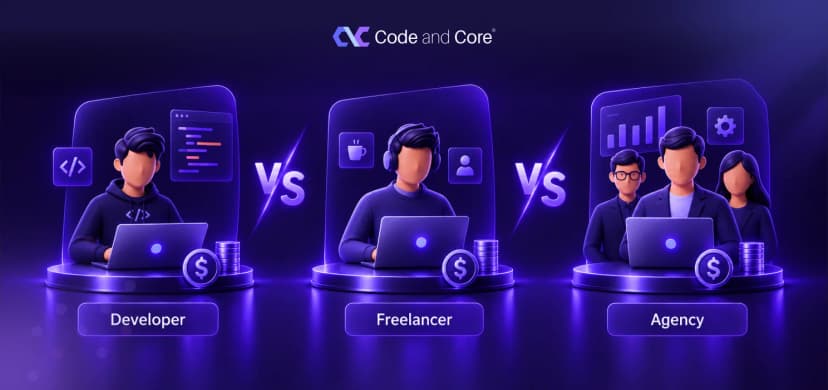
A freelancer works well for a small, clear task, such as fixing a landing page. You get low cost and direct contact, but you also carry the risk if that one person gets sick or busy.
An in-house developer makes sense when you have steady work every single week. The cost is higher, and hiring can take months.
An agency fits best when the project needs several skills together: design, front-end code, testing, and project management. You get a full team and a backup if someone leaves. That is why many growing companies pick agencies for redesigns and new products.
Not sure which way to go? Our cost breakdown of dedicated developer vs freelancer vs agency puts real numbers next to each choice. Once you know an agency is right, come back and use the steps below.
Agencies can only be judged against a clear goal. Spend one hour on this first. It saves weeks later.
✔ Your goal in one sentence. Example: “Get 30% more demo requests from mobile visitors.”
✔Your pages and features. A rough list is enough. No need for perfect detail.
✔ Your budget range. Share it early. Good agencies use it to suggest the right scope.
✔ Your deadline and why it matters. A product launch date is different from a “sometime this year” wish.
✔ Who decides. Name one person who approves work, so feedback does not turn into chaos.
Here is the full journey on one page. Each step gets its own section below.

The six steps of a safe front-end agency hiring process
| Tip
Give each step a due date. A simple plan such as one week to shortlist, one week for calls, and one week for the pilot keeps you from dragging on for months. |
A portfolio is the closest thing to a test drive. But most people only look at the pretty screenshots. Do more than that.

Four quick checks when you evaluate a dev agency portfolio
Open the live sites
Click the link. Does it load? Is it fast? Test it on your phone, then run it through Google PageSpeed Insights. A real agency will not mind you checking.
Look for results, not just looks
A good case study says what changed. Faster pages, better search rankings, more orders. Vague words like “beautiful” and “modern” tell you very little.
Ask what they personally built
Some agencies list projects that a partner or a past employee did. Ask which team members worked on it and whether they are still there.
A real example of what proof looks like
In our own portfolio, the Sport School site lists a 95 Lighthouse speed score, and the Elsight site lists a 97 Google score with an A grade in GTmetrix. Those are numbers you can test yourself. Quilt Software is listed for performance work and full responsiveness on all devices. That is the level of detail you should expect from any agency.
Now the interview. These questions to ask a web development agency are simple, but the answers reveal a lot. Watch for clear, calm replies. Long, foggy answers are a warning.
About their process
✔ How do you start a project, and what do I get in the first two weeks?
✔ Do we see work in progress, or only at the end?
✔ How do you handle changes after we agree on scope?
About the code
✔ Which frameworks do you use, and why for my project?
✔ Do you use TypeScript and code reviews? (See why in our post on the benefits of TypeScript.)
✔ Will I own the code and the design files at the end?
About quality
✔ Which devices and browsers do you test on?
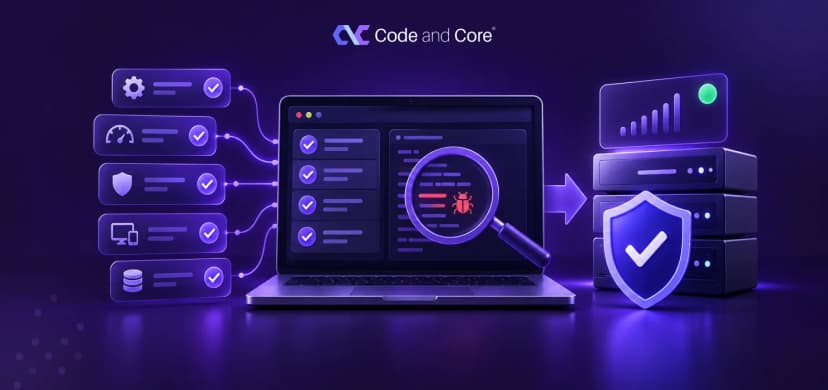
✔ How do you check speed and accessibility before launch?
✔ Who tests the work, the developer or a separate QA person? Our guide on why regular QA audits matter explains the difference.
About people and money
✔ Who will actually work on my project, and can I meet them?
✔ How fast do you reply, and in which time zone?
✔ What is not included in the price?
✔ What happens after launch, and what does support cost?
| Note
Ask about mobile testing every time. More people browse on phones than ever, and our guide on making a website mobile-friendly shows how much that affects results. |
During calls, keep this table open. It turns feelings into facts.
| Area | Red flag | Green flag |
| Portfolio | Only screenshots, no live links | Live sites with clear results |
| Communication | Slow replies before you have paid | Fast, clear answers from day one |
| Pricing | One vague number, hidden extras | Itemized quote with scope |
| Testing | “We test at the end” | Testing built into every sprint |
| Team | Cannot say who will work on it | Named people you can meet |
| Contract | Code ownership is never mentioned | Ownership stated in writing |
| Attitude | Says yes to everything | Pushes back with good reasons |
Want a longer list? Read our related post on 7 red flags before you hire a front-end development team.
You do not need to be technical to check quality. Ask the agency what targets they aim for. Google publishes three simple ones, called Core Web Vitals.

Core Web Vital
In plain words: the main content should appear within 2.5 seconds, the page should respond to a tap within 200 milliseconds, and things should not jump around while loading. If an agency cannot talk about these, that tells you something.
Accessibility matters as well. The Web Content Accessibility Guidelines (WCAG) are the global standard. Ask if the agency builds to WCAG 2.2 level AA. Our post on responsive web design covers the device side of the same story.

Code and Core
When two agencies both sound great, feelings take over. A simple scorecard keeps you fair. Give each agency a mark out of the weight shown, then add it up.

A suggested scorecard. Change the weights to match your project
Notice that price is only 10 points. The cheapest quote often becomes the costliest project. If you are still deciding between hiring models, our comparison of dedicated developer vs freelancer vs agency can help.

Good design but weak code and support
A radar view like this one helps too. Agency B might win on design, but Agency A is stronger everywhere else. You can spot that in seconds.
Example scenario. Maya runs an online candle shop. She gets two quotes for a new front end.
Agency A is cheaper. It sends a polished deck but no live links. Replies take two days. The contract does not say who owns the code.
Agency B costs a bit more. It shares three live sites, offers a small paid pilot, and explains its mobile testing. It names the developer who will work on her shop.
Maya runs the pilot with both. Agency B delivers a working product page on time and answers questions within hours. Agency A misses its deadline. The decision becomes easy, and it was made with evidence, not a hunch.
Before you sign, confirm these points in writing.
✔ Scope, deliverables, and a clear list of what is not included.
✔ Milestones tied to payments, not one big upfront payment.
✔ You own the code, designs, and content on final payment.
✔ A warranty or bug-fix period after launch.
✔ An NDA if your idea or data is sensitive.
✔ A named contact and a reply-time promise.
✔ Pricing model that fits: fixed price, hourly, or dedicated team. Our post on hiring dedicated frontend developers explains when a dedicated team is worth it.
| Did you know?
Many agencies, including Code and Core, offer flexible hiring such as 40, 80 or 160 hours a month. That lets you start small and grow only when you are happy. |
Choosing on price alone. A low quote often hides missing pieces such as testing, revisions, or support. You pay for them later, usually at a higher rate.
Skipping references. A five-minute call with a past client tells you more than a ten-page proposal. Ask what went wrong on their project and how the agency fixed it. Every team has a rough day. What matters is the response.
Hiring for the demo, not the delivery. The people in the sales call are not always the people writing your code. Ask to meet the developers before you sign.
Ignoring what happens after launch. Websites need updates, security fixes, and small improvements. Choose a partner who offers maintenance so you are never left alone with a bug on a Friday night.
Changing the scope every week. This one is on the client side. Fresh ideas are fine, but each change costs time. Keep a “later” list and finish the first version before you add more.
Once you have picked a team, a healthy start follows a pattern. If yours looks very different, ask why.
Week 1: discovery and plan
The team asks questions, reviews your brief, and shares a simple plan with milestones. You should meet your project manager and know who to contact.
Week 2: design and structure
You see wireframes or design screens, not just words. You give feedback in one round, from one decision-maker.
Weeks 3 and 4: the first build sprint
You should get a link to a working staging page, even if it is unfinished. Seeing real progress by the end of month one is the clearest sign of a reliable team. If you see nothing but promises, raise it right away.
Save this. Tick each line before you sign.
✔ I wrote a clear brief with goals, budget, and deadline.
✔ I shortlisted three to five agencies.
✔ I opened live portfolio sites and tested them on my phone.
✔ I spoke to at least two past clients.
✔ I asked about testing, speed, and accessibility.
✔ I met the people who will actually do the work.
✔ I ran a paid pilot or reviewed sample work.
✔ I compared agencies using a scorecard.
✔ The contract states ownership, milestones, and support.

Code and Core
The best agency is not the loudest or the cheapest. It is the one that shows proof, answers plainly, and treats your project like its own. Follow this front-end agency hiring guide, and you will spot the right partner much faster.
If you would like to talk it through, our team is one message away.
Sources
WebAIM, “The WebAIM Million”: webaim.org/projects/million
Google web.dev, “Web Vitals”: web.dev/articles/vitals
Think with Google, mobile page speed benchmarks: thinkwithgoogle.com
W3C, “Web Content Accessibility Guidelines (WCAG) Overview”: w3.org/WAI/standards-guidelines/wcag
Google, “PageSpeed Insights”: pagespeed.web.dev

Code and Core

Ask who will work on your project, how they test on mobile, how they handle changes, what happens after launch, and who owns the code.
Open the live sites, test them on your phone, check their speed, and ask what result each project achieved and what the agency personally built.
Three to five is enough. Fewer limits your choice, and more makes comparing hard.
Yes. A small paid task shows how the team communicates, codes, and meets deadlines before you commit to a large contract.
Catch wind of the latest technologies, strategies, and information that are set to boost your business operation. We update frequently!