Development 08.10.2026
08.10.2026 SpeedyGo: One plugin to make your WordPress website faster
 Corvexa: AI that turn more website visitors into qualified leads.
 Energy
 Oil and gas
 Transportation
 E-commerce
 Healthcare
 Real Estate
 Fintech
 Manufacturing
 Education
 Agriculture
 Travel
 Cyber Security
 Crypto
 Law and Order
 Entertainment
 Hospitality
 Logistics
 Non-profit
 Digital Industry
 Venture Capital
A Quick Guide on the Right Software Development Approach for Enterprises in 2023

 08/10/2026


| Quick summary
Everyone says they build AI agents now. Very few actually do. This guide gives you 10 clear questions to ask any AI agent development company before you sign, plus the good and bad answers to listen for, so you avoid wasted budget and risky launches.
|
A few months ago, a founder told us about his “AI agent.” He had paid a vendor for it. It turned out to be a chatbot with a fancy name. It answered questions from a script and could not do a single task by itself.
He is not alone. Analysts even have a name for it: agent washing. Old chatbots and automation tools get a new label, and buyers pay more for the same thing.
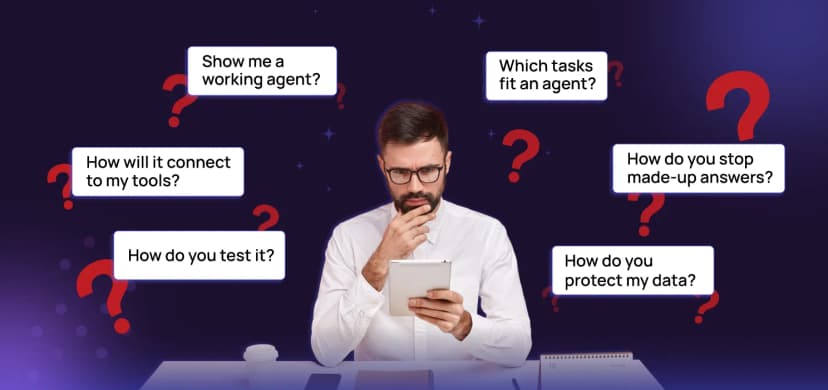
The fix is simple. Ask better questions before you hire. This guide gives you ten of them, written in plain English, so you can judge any AI agent development company with confidence.
An AI agent is software that works toward a goal. It can make a plan, use tools like email, calendars, databases or a CRM, take actions, and check whether it worked. If it is unsure, it asks a person.
A chatbot is different. It answers a question and stops. Automation is different too. It follows fixed steps and breaks when something unexpected happens.

What is an AI agent and what is not
AI company Anthropic explains the same idea in its guide to building effective agents: agents decide their own steps and use tools, while workflows follow paths that are set in advance. It also advises starting with the simplest solution that works. That is good advice for buyers, too.

How a real Al agent works
| Did you know?
Not every problem needs an agent. If a task follows the same steps every time, simple automation is cheaper and more reliable. A good agentic AI development company will tell you this, even if it means a smaller project. |
Because the market is crowded and the stakes are real. Gartner predicts that over 40% of agentic AI projects will be canceled by the end of 2027, due to rising costs, unclear business value, or weak risk controls.

Gartner prediction for agentic AI projects. Source: Gartner, June 2025
The same Gartner release says that of the thousands of vendors claiming agentic features, only about 130 are real. The rest are rebranded chatbots and tools.

Source: Gartner press release, June 2025. The funnel is for illustration and is not drawn to scale
The lesson is not to avoid AI agents. It is to hire carefully, start small, and measure results. Now let’s get to the questions.

The 10 questions to ask an Al agent development company
Question 1: Can you show me a working agent, not just a demo video?
A recorded demo can hide a lot. Ask to see a real agent running on real tasks, ideally in a test environment where you can try your own examples.
Good answer: a live walkthrough, plus a client reference you can contact. Red flag: only slides and screen recordings.
Question 2: Which tasks should the agent do, and which should stay with people?
The best custom AI agent development starts with one narrow, valuable task, not “automate everything.” A good partner helps you decide how much freedom the agent should get. Here is a simple way to think about it.
| Autonomy level | What the agent does | Example | Control needed |
| 1. Read only | Finds and summarizes information | Searches company documents | Strict access limits |
| 2. Suggests | Drafts, and a person sends | Drafts a customer reply | Human review |
| 3. Acts with approval | Does the work after a click | Issues a refund once approved | Approval rules, logs |
| 4. Acts alone | Handles low-risk tasks fully | Tags and routes support tickets | Limits, monitoring, rollback |
Good answer: “Let’s start at level two or three and move up as trust grows.” Red flag: “Full autonomy from day one.”
Question 3: How will the agent connect to my tools and data?
An agent is only useful if it can reach your systems: email, CRM, support desk, database, or website. Ask which integrations are needed and how they will be secured. Open standards such as the Model Context Protocol are making tool connections easier, but each one still needs careful setup.
Good answer: a clear list of integrations, with permissions limited to what the agent needs. Red flag: “It connects to everything” with no details.
Question 4: How do you stop the agent from making things up?
AI models sometimes state wrong things with confidence. A strong team reduces this by grounding the agent in your own approved information, limiting what it can say, and sending unsure cases to a person.
Good answer: they explain how answers are tied to your data and how errors are caught. Red flag: “Our model does not hallucinate.”

Code and Core
Question 5: How will you test the agent, and how will we measure success?
You cannot improve what you do not measure. Ask for a test set built from your real cases, plus clear targets such as accuracy, time saved, or tickets resolved without help.
Good answer: written success metrics before building starts. Red flag: “We will see how it feels.”
Question 6: How do you protect my data and defend against attacks?
Agents can read private data and take actions, so security matters a lot. Ask where data is stored, who can see it, and whether it is used to train outside models. Also ask about prompt injection, where hidden instructions in an email or web page trick an agent. The OWASP Top 10 for LLM Applications lists this and other risks, and the NIST AI Risk Management Framework offers a wider risk guide.
Good answer: NDA, limited permissions, logging, and a security review. Red flag: “Security is handled by the AI provider.”
Question 7: What guardrails and human approval steps will exist?
Think of guardrails as seat belts. They include spending limits, blocked actions, approval steps for risky moves, and a quick off switch.
Good answer: a list of actions the agent can never do alone. Red flag: no way to pause or undo what the agent has done.
Question 8: What will it really cost, including running costs?
There are two bills: building the agent and running it. Running costs include model usage, hosting, monitoring, and updates. In the GoodFirms 2026 survey, 71.4% of AI companies priced an AI MVP between $50,000 and $125,000, and AI features can add up to 30% to a project’s cost.
Your AI agent development services quote should separate build cost from monthly running cost. Our guide on dedicated teams vs project-based hiring can help you pick a pricing model.
Good answer: an itemized estimate with a cap on usage costs. Red flag: a single number and “usage is extra.”
Question 9: Who owns the agent, the prompts, and the data?
You should own your data, your prompts, your workflows, and the code built for you. Ask whether the agent can switch to another AI model later, so you are not locked in.
Good answer: ownership in the contract and a model-flexible design. Red flag: the vendor keeps the core logic on its own platform.
Question 10: What happens after launch?
Agents need ongoing care. Models change, your tools change, and edge cases appear. Ask who watches the agent, how problems are reported, and how fixes are released. Maintenance matters here as much as for any software. See why in our post on long-term maintenance.
Good answer: monitoring, a support plan, and regular reviews. Red flag: “Once it is live, you are on your own.”
| Note
Ask all ten questions in writing and compare answers across two or three companies. Clear, specific replies are a better sign than confident, vague ones. |
The best projects follow four steps. First, discover one task and write down how success is measured. Second, prototype a thin slice that works end to end. Third, pilot it with real people reviewing the results. Only then do you scale and monitor.

What does a safe path to a live agent look like
This approach keeps cost low and learning high. Our post on the hidden benefits of rapid app prototyping explains why small tests save so much time.
Agents shine where work is repeated, involves several tools, and follows clear goals. Here are common starting points for custom AI agent development.
Notice the pattern. Each task has a clear start, a clear finish, and a way to check the result. That is what makes an agent testable, and testable agents are the ones that survive.
Ready-made agents are quick to start and fine for common jobs such as meeting notes or basic support. Custom agents make sense when your process is unique, when the agent must work inside your own systems, or when your data is too sensitive to share with a general tool.
A fair AI agent development company will tell you if an off-the-shelf tool is enough. That honesty is itself a good sign. If your needs are more specific, custom AI agent development gives you control over how the agent behaves, what it can access, and how it grows with your business.
Example scenario. Priya runs an online store that gets hundreds of “Where is my order?” emails each week. Two vendors pitch her an “AI agent.”
Vendor A offers a chatbot that answers general questions. It cannot look up an order. It is sold as an agent.
Vendor B proposes an agent that reads the email, checks the order system, drafts a reply with real tracking details, and sends it for approval at first. Refunds always need a person to approve. It shares success targets and a two-stage pilot.
Priya picks Vendor B. After the pilot shows strong results, she lets the agent send simple tracking replies alone while refunds stay with her team. Slow, safe, and measurable.

Code and Core
It cannot show a live agent or a client reference.
It promises full automation of complex work right away.
It cannot explain how the agent is tested.
It has no plan for security or data protection.
It will not state who owns the code and data.
Costs are vague, especially running costs.
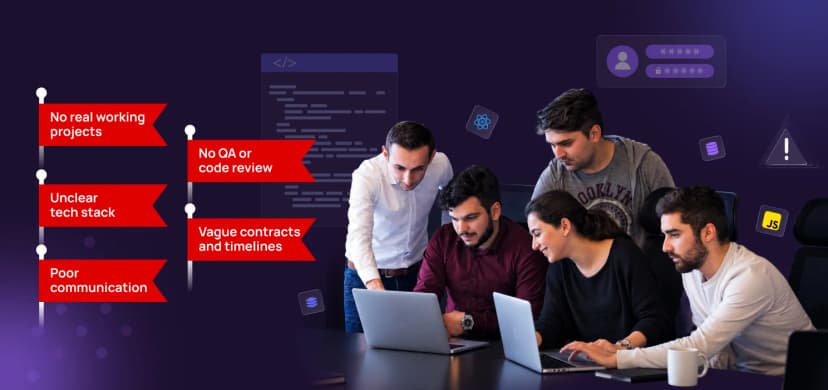
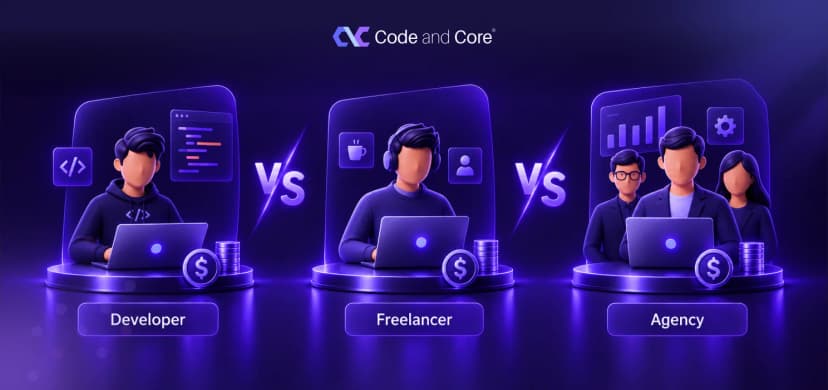
For more general warning signs, see our guide on red flags before you hire a development team. And if you are weighing the hiring route, dedicated developer vs freelancer vs agency compares them.
Code and Core is an ISO 9001 certified studio with 30+ dedicated developers. Our AI technology services include custom AI solutions, AI chatbots, agentic AI development, and LLM development. You can see AI-related projects such as Everneed Ai and Insoundz in our portfolio. We start with a clear task, work in short stages, and sign an NDA whenever you need one.
If you already have a quote, we are happy to review it against these ten questions.
AI agents can save real time, but only when they are built for a clear task, tested properly, and watched after launch. The company you choose makes the biggest difference.
Use the ten questions above as a checklist. If an AI agent development company answers them clearly and honestly, you are in good hands. If not, keep looking.
Sources
Gartner, “Gartner Predicts Over 40% of Agentic AI Projects Will Be Canceled by End of 2027” (June 25, 2025): gartner.com
Anthropic, “Building effective agents”: anthropic.com/engineering/building-effective-agents
OWASP, “Top 10 for Large Language Model Applications”: owasp.org
NIST, “AI Risk Management Framework”: nist.gov
Model Context Protocol: modelcontextprotocol.io
GoodFirms, “Custom Software Development Cost Survey 2026”: goodfirms.co

Code and Core
Catch wind of the latest technologies, strategies, and information that are set to boost your business operation. We update frequently!