Development 25.09.2026
25.09.2026 SpeedyGo: One plugin to make your WordPress website faster
 Corvexa: AI that turn more website visitors into qualified leads.
 Energy
 Oil and gas
 Transportation
 E-commerce
 Healthcare
 Real Estate
 Fintech
 Manufacturing
 Education
 Agriculture
 Travel
 Cyber Security
 Crypto
 Law and Order
 Entertainment
 Hospitality
 Logistics
 Non-profit
 Digital Industry
 Venture Capital
A Quick Guide on the Right Software Development Approach for Enterprises in 2023

 15/10/2026


| Quick summary
How much should you spend on your first version? This guide breaks down MVP development costs in 2026 in plain English. You will see price ranges by approach, the cost to build a SaaS MVP, where the money goes, hidden costs, timelines, and ways to save without hurting quality.
|
A founder once told us, “I spent eight months and most of my savings building every feature I could think of. Then I launched, and almost nobody signed up.” It is a painful story, and it is common. The mistake was not the idea. It was building too much, too soon, before learning what people actually wanted.
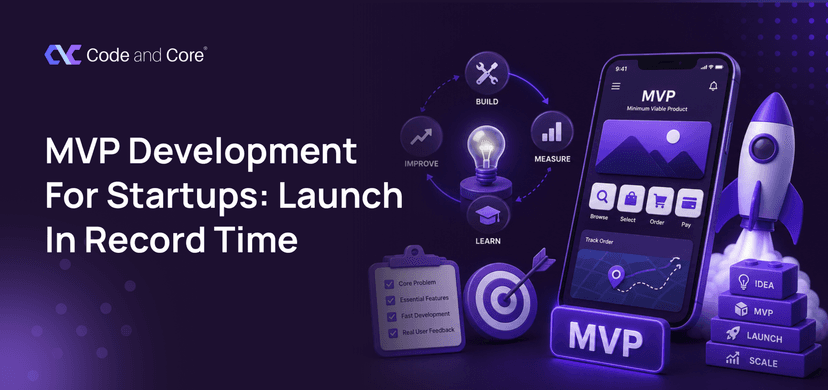
That is exactly what an MVP, or minimum viable product, is for. It is the smallest version of your product that real users can try. And the good news is that it costs far less than a full build.
So how much? Let’s look at real numbers, and at what makes them move.
Short answer: most MVPs cost between $5,000 and $100,000 or more, depending on how you build them. A simple no-code MVP can start around $5,000, while a custom-built one usually lands between $30,000 and $100,000+. According to Technource, ranges are about $5K to $25K for no-code, $15K to $50K for low-code, and $30K to $100K+ for custom builds.

Sources: Technource MVP statistics (no-code, low-code, custom) and GoodFirms 2026 survey (AI MVP). Published guides vary, so treat these as ballparks
For AI-powered products, the GoodFirms 2026 survey found that 71.4% of AI companies priced an AI MVP between $50,000 and $125,000. And another 2026 pricing guide breaks the market into three levels: a clickable prototype ($5K to $15K), a working app that can find product-market fit ($15K to $50K), and production-grade code that lasts beyond the MVP ($50K to $150K).
| Note
Published guides do not agree exactly, because they come from different companies and regions. Use these numbers as ballparks, then ask for itemized quotes for your own idea. |
Each approach has trade-offs. Here is a simple comparison.
| Approach | Typical cost | Speed | Best for | Watch out for |
| No-code | $5K to $25K | Fastest | Testing a simple idea | Limits on custom features |
| Low-code | $15K to $50K | Fast | Internal tools, early products | Platform lock-in |
| Custom-built | $30K to $100K+ | Moderate | SaaS, marketplaces, scale | Higher upfront cost |
| AI-powered | $50K to $125K | Moderate | AI-first products | Data and running costs |
Because building the wrong thing is the most expensive mistake. In an analysis of founder post-mortems by CB Insights, 38% of failed startups ran out of cash, and 35% said there was no market need, as reported by SmartCompany. Those two problems feed each other: you spend money on a product nobody needs.

Source: CB Insights, as reported by SmartCompany
An MVP is cheap insurance. It lets you test demand before you spend big. In a GoodFirms survey of 680 businesses, 91.3% said they had already launched a product using an MVP approach, and 53.4% used an MVP to attract investors.
These words get mixed up, and the mix-up can cost money.
A proof of concept checks that something is technically possible. Users never see it. A prototype is a clickable model that shows how the product will look and flow. It has little or no real code behind it. An MVP is a real, working product with just enough features for real people to use and pay for.
Each step costs more than the last, and each answers a different question. A proof of concept asks, “Can we build it?” A prototype asks, “Does the flow make sense?” An MVP asks, “Do people actually want this?” Match the step to your biggest unknown, and do not pay for the next one before you need it.
Number and complexity of features: This is the biggest lever. Ten simple screens cost much less than three screens with complex logic. Each extra user role, report, or integration adds time.
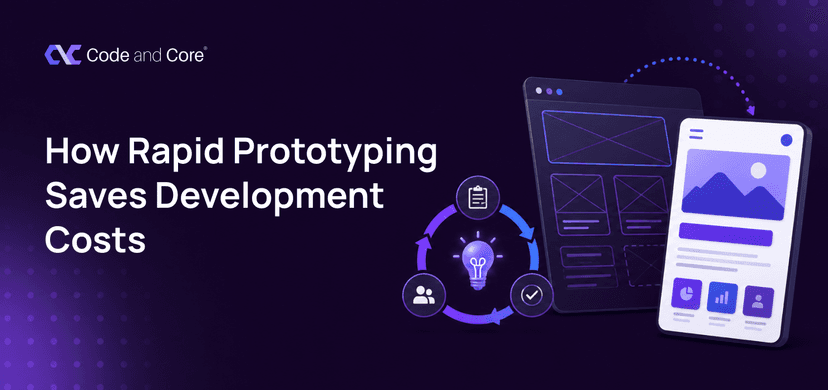
Design quality: A clean, simple design is enough for an MVP. Custom animations and pixel-perfect polish can wait. A clickable prototype helps you test the flow before any code is written. Our post on the hidden benefits of rapid app prototyping shows how this saves money.
Platform choice: One platform costs less than two. A web app is often cheaper to start than separate iOS and Android apps. If you need both, cross-platform tools can share one codebase. See native vs. cross-platform.
Team location and model: Rates vary by region. In the GoodFirms survey, 56.3% of companies charged $20 to $50 an hour, while Western teams often cost much more. Do not judge only by the hourly rate. Judge by total cost for the same scope.
Integrations and data: Payments, email, maps, and AI services each need setup, testing, and sometimes monthly fees.
Most of an MVP budget goes to the people who design, build, and test it, not to tools or servers. Here is a typical split.

Notice that testing gets its own slice. Skipping it saves money today and costs more later. Our post on why regular QA audits matter explains why.

This single decision can cut your startup MVP cost by half. List every feature idea, then sort it by impact and effort.

✔ Solve one problem well. One clear job beats ten half-built ones.
✔ Keep sign-up simple. Fewer steps mean more users.
✔ Build the core flow end to end. A user should reach value quickly.
✔ Add basic analytics. You need to see what people do.
✔ Leave “nice to have” for phase 2. Write it down so you don’t lose anything.
| Tip
Ask yourself, “If we removed this feature, could a user still get the main benefit?” If yes, it does not belong in the MVP. |
SaaS products need more than one screen. Even a lean version usually includes sign-up and login, a dashboard, a billing system, an admin area, and email notifications. Each is a small project on its own, which is why the cost to build a SaaS MVP often falls in the custom range of $30,000 to $100,000 or more.
Three things push SaaS costs up:
✔ Billing. Subscriptions, invoices, failed payments, and refunds take careful work.
✔ Multiple accounts and roles. Teams, permissions, and data separation add complexity.
✔ Security. Customer data needs strong protection from day one.
Hosting is the other cost. Early on it can be modest, but it grows with users. Our guide to AWS and cloud infrastructure for scaling explains how to plan for that without overspending.
In the GoodFirms survey, small MVP projects typically took one to three months. A realistic plan has clear phases.

An example 12-week MVP plan. Small projects often take one to three months, per the GoodFirms 2026 survey
Be careful with promises of a full product in two weeks. Fast delivery is possible with a tight scope, but not by skipping testing.
Many founders budget only for the build. Add these too.
✔ Scope changes. The GoodFirms survey says these add 10% to 25% on many projects.
✔ Maintenance. Yearly upkeep often runs 10% to 20% of build cost. See long-term maintenance.
✔ Hosting and tools. Servers, email, analytics, and monitoring.
✔ Third-party fees. Payment processors, maps, and AI services often charge per use.
✔ Legal and compliance. Terms, privacy policy, and data rules.
✔ Marketing. An MVP with no users teaches you nothing. Budget to reach people.
| Did you know?
In a 2026 GoodFirms release, 90.6% of software companies said they use AI tools in development, and 61% expect AI to cut project budgets by 10% to 25%. Ask any team how they use AI to save you money. See the GoodFirms announcement. |
Example scenario. Karan wants to build a simple invoicing tool for freelancers. His budget is $40,000. He is tempted to add reports, team accounts, a mobile app, and ten integrations.
After a short discovery session, he cuts the first release to four things: sign-up, create an invoice, send by email, and accept one payment method. He sets aside about 20% as a buffer for changes and 10% for the first year of upkeep.
He launches in about three months. Early users ask for recurring invoices, not reports. Karan now knows what to build next, and he learned it for a fraction of the cost of the full vision.
Building a “mini” full product. An MVP is not a small copy of your dream. It is a test of one idea. If your list has more than five or six features, it is probably too big.
Choosing the lowest quote. A very low price often leaves out design, testing, hosting, or support. You then pay for them later, usually at a higher cost.
Forgetting the money after launch. Hosting, fixes, and marketing start the day you go live. Keep part of your budget in reserve.
Skipping user feedback. If you only watch numbers and never talk to users, you miss the “why” behind them.
Changing direction every week. Fresh ideas are good, but each change costs time. Collect them in a list and review them after each phase.
If you can answer these clearly, you are ready to ask for quotes. If not, a short discovery phase is the best money you can spend.

Keep the loop going. After your soft launch, look at what users do, not just what they say. Then decide whether to improve, pivot, or scale.
MVP development cost is not one number. It depends on how you build, how many features you include, and how well you plan. The smartest founders start small, prove demand, and grow with real feedback. If you remember one thing, make it this: the cheapest MVP is the one that teaches you the most for the least money. Keep the scope tight, keep a buffer, and choose a partner who tells you the truth.

In the GoodFirms 2026 survey, small MVP projects typically took one to three months.
A custom SaaS MVP usually falls in the custom range of $30,000 to $100,000 or more, because it needs sign-up, billing, dashboards and admin tools.
Expect scope changes of 10% to 25%, yearly maintenance of 10% to 20%, hosting, third-party tools, and marketing.
Focus on one core problem, list must-have features only, build in phases, reuse proven tools, and choose a team with itemized pricing.
Catch wind of the latest technologies, strategies, and information that are set to boost your business operation. We update frequently!