Technologies 12.10.2026
12.10.2026 SpeedyGo: One plugin to make your WordPress website faster
 Corvexa: AI that turn more website visitors into qualified leads.
 Energy
 Oil and gas
 Transportation
 E-commerce
 Healthcare
 Real Estate
 Fintech
 Manufacturing
 Education
 Agriculture
 Travel
 Cyber Security
 Crypto
 Law and Order
 Entertainment
 Hospitality
 Logistics
 Non-profit
 Digital Industry
 Venture Capital
A Quick Guide on the Right Software Development Approach for Enterprises in 2023

 12/10/2026


| Quick summary
Should you build your own chatbot or buy a ready-made one? This guide compares custom AI chatbot development with off-the-shelf tools in plain English. You will see when each one wins, what it costs over time, the risks nobody mentions, and how to pick an AI chatbot development company.
|
Picture a customer typing, “Where is my order?” into your website chat. The bot replies, “Sorry, I don’t understand.” She tries again. Same answer. She closes the tab and emails your competitor.
That small moment is the whole debate. A chatbot that cannot do real work is worse than no chatbot at all.
The good news is that you have choices. You can buy a ready-made tool in an afternoon, or build something tailored to your business. Neither is always right. Let’s work out which one fits you.
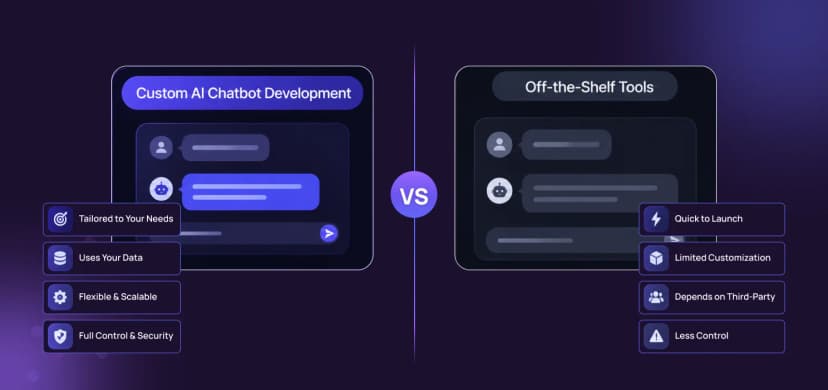
An off-the-shelf chatbot is a finished product. You sign up, add your FAQs, paste a snippet on your website, and go live. Think of it as renting a furnished apartment.
Custom AI chatbot development means building a chatbot around your business. It uses your data, plugs into your systems, speaks in your brand voice, and follows your rules. Think of it as designing your own house.
| Factor | Off-the-shelf | Custom |
| Time to launch | Hours to days | Weeks to months |
| Cost model | Monthly fee, often by usage | Build cost plus running cost |
| Customization | Limited to settings and templates | Fully tailored |
| Integrations | Common apps only | Any system you use |
| Data control | Held on the vendor’s platform | Under your control |
| Brand voice | Basic | Deeply matched |
| Scaling | Tied to the vendor’s plans | Designed for your volume |
| Best for | FAQs, simple lead capture | Complex, high-stakes, enterprise use |
Do not let anyone tell you custom is always better. Ready-made tools are a smart choice in many cases.
The limits show up later. Many tools cannot read your order system, cannot follow a special approval flow, and keep your data on their servers. Pricing can also climb as your chats grow.
Custom builds shine when the chatbot has to do real work inside your business.
This is the territory of the enterprise AI chatbot. It does not only chat. It looks things up, takes actions, hands over to people, and reports what it learns.

| Tip
Be wary of anyone who sells only one option. A good AI chatbot development company will happily tell you when an off-the-shelf tool is enough. |
This is where many businesses get surprised. A Gartner survey of 5,728 customers found that 64% would prefer companies did not use AI in customer service, and 53% would consider switching to a competitor if they learned a company planned to use it. The top worry was that AI makes it harder to reach a real person.

Gartner survey of 5,728 customers. Source: Gartner findings, via Call Centre Helper
That does not mean “avoid chatbots.” It means design them well. Gartner also predicts that agentic AI will resolve 80% of common customer service issues by 2029, with lower operating costs. Customers will accept bots that solve problems quickly and hand over to a person when needed.
| Note
Whatever you choose, build an easy path to a human. A “Talk to a person” button is one of the cheapest trust-builders you can add. |
In 2024, a Canadian tribunal ruled on a case where an airline’s chatbot gave a customer wrong information about bereavement fares. The airline argued the chatbot was a separate entity. The tribunal disagreed. According to the American Bar Association summary of Moffatt v. Air Canada, the airline was held responsible for everything on its website, whether it came from a static page or a chatbot, and was ordered to pay $812.02 in total.
The amount was small. The lesson is big: your chatbot speaks for your company.
This matters when you compare options. With a custom build, you decide what sources the bot may use, what it must never say, and how answers are checked. With a ready-made tool, you rely on the vendor’s controls. The OWASP Top 10 for LLM Applications lists other risks worth asking about, such as prompt injection and data leaks.

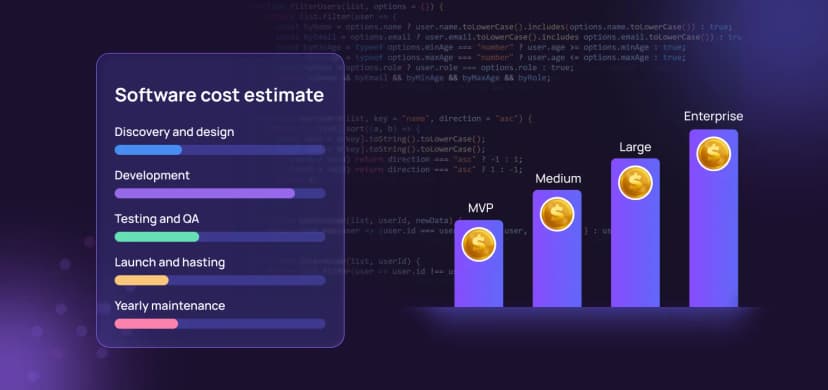
Off-the-shelf tools look cheaper in month one. But subscriptions often grow with conversations, seats, and add-ons. A custom build costs more upfront, then usually settles into running costs such as hosting, model usage, and maintenance.

For a sense of custom pricing, the GoodFirms 2026 survey found that 71.4% of AI companies priced an AI MVP between $50,000 and $125,000, and that AI features can add up to 30% to a project’s cost. A simple custom chatbot can cost less than a full AI product, so ask for a phased quote. The same survey notes that yearly upkeep is usually 10% to 20% of build cost.
The real question is not “which is cheaper?” It is “which gives the better result for the money, over two or three years?” Our post on dedicated teams vs. project-based hiring can help with the budget model.
The right chatbot depends on what your customers need most. Here are common starting points.
Notice that the more a chatbot touches money, health, or personal records, the stronger the case for a custom build with tight controls.

If you do go custom, it helps to know the moving parts. A strong enterprise AI chatbot has more than a language model.

What goes inside an enterprise AI chatbot

Start with one job, such as order tracking or appointment booking. Prove it works, then add more. This is the same idea behind our post on rapid prototyping: small tests save time and money. Testing matters just as much, so read why regular QA audits prevent costly problems.
Example scenario. Meera runs a small clinic. She sets up a ready-made chatbot for opening hours and doctor profiles. It works well for three months.
Then patients start asking to book, change, or cancel appointments. The tool cannot see her scheduling system, and patient details are too sensitive to store on a vendor’s platform.
Meera works with a development team to build a custom chatbot. It connects to the booking system, confirms slots, sends reminders, and passes anything medical straight to the staff. The earlier bot was not a waste. It showed her exactly what patients wanted.
Yes, and it is often the smartest one. Some teams use a ready-made platform for the basics, then add a custom layer on top. The custom layer connects to your systems, applies your business rules, and keeps sensitive data under your control.
This hybrid route lowers upfront cost and still gives you room to grow. It also reduces risk: you test the idea with real users before investing in a full build. The key is to choose tools that let you export your content and data later, so you never feel trapped.
Write the answers down. If you cannot answer several of them, you are not ready to buy anything yet, and a short discovery session will save you money.
If custom looks right, the company you pick matters as much as the idea. Use this checklist.
Starting too big. A chatbot that tries to do everything usually does nothing well. Pick one job first.
Feeding it messy content. A chatbot is only as good as its knowledge. Outdated pages create wrong answers.
Hiding the human option. Customers need a way out. Make it obvious.
Never reviewing chats. Real conversations show what is missing. Review them every week at the start.
Ignoring upkeep. Products, prices, and policies change. Your chatbot must change with them. Our guide on long-term maintenance explains why.

Code and Core is an ISO 9001-certified studio with 30+ dedicated developers and clients in 25+ countries. Our AI technology services include AI chatbot development, custom AI solutions, agentic AI, and LLM development. You can see AI-related projects like Everneed AI and Insoundz in our portfolio. We work under an NDA, start with a clear use case, and build in stages.
Off-the-shelf chatbots are fast and affordable. Custom AI chatbot development gives you control, depth, and room to grow. The right choice depends on what your chatbot must do, how sensitive your data is, and how much you expect to scale.
If you are unsure, start small, learn from real conversations, and upgrade when the need is clear. And whichever path you take, remember that your chatbot speaks for your brand.

Choose custom when the chatbot must connect deeply to your systems, handle sensitive data, follow unique workflows, or scale to high volume.
In the GoodFirms 2026 survey, 71.4% of AI companies priced an AI MVP between $50,000 and $125,000. A simpler chatbot can cost less, and running costs are extra.
Often yes. If you need simple FAQ answers and lead capture without deep system connections, a ready-made tool is quick and affordable.
Yes. In the 2024 Moffatt v. Air Canada decision, a tribunal held the airline responsible for wrong information given by its chatbot.
Catch wind of the latest technologies, strategies, and information that are set to boost your business operation. We update frequently!