Development 21.10.2026
 SpeedyGo: One plugin to make your WordPress website faster
 Corvexa: AI that turn more website visitors into qualified leads.


 Energy
 Oil and gas
 Transportation
 E-commerce
 Healthcare
 Real Estate
 Fintech
 Manufacturing
 Education
 Agriculture
 Travel
 Cyber Security
 Crypto
 Law and Order
 Entertainment
 Hospitality
 Logistics
 Non-profit
 Digital Industry
 Venture Capital

A Quick Guide on the Right Software Development Approach for Enterprises in 2023


 21/10/2026


| Quick summary
You send the same brief to three teams and get three very different prices. This guide explains why. Using fresh 2026 survey data from more than 300 web development companies, it shows typical custom web application development costs, what actually drives web app development pricing, which costs hide after launch, and how to get an estimate you can trust.
|
A founder once showed us three quotes for the same web application: $25,000, $62,000 and $140,000. “Is someone lying?” she asked.
Probably not. The teams were pricing different things. One counted only the screens. One included testing and security. One added features she never asked for.
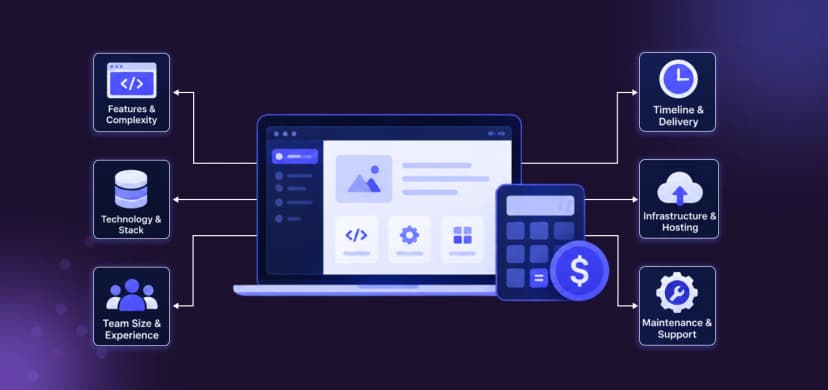
That is the hard truth about custom web application development cost. The price is not set by the brief alone. It is set by a small number of decisions that most buyers never see. This guide shows you those decisions, one by one, so you can read any quote with confidence.
Short answer: the most common quote for a custom web application is $20,000 to $50,000. That comes from the GoodFirms 2026 Website Development Cost Survey, which gathered answers from more than 300 web development companies in 31 countries. About 35.5% of firms named that range, and another 19% quoted $50,000 to $75,000. Typical delivery took 8 to 16 weeks, and nearly 68% of firms landed between 8 and 28 weeks.
Here is how a custom web app compares with other project types.
| Project type | Most common cost range | Share of firms | Typical timeline |
| Basic website or MVP | $1,000 to $3,000 | 59.9% | 2 to 4 weeks |
| Mid-sized website | $5,000 to $20,000 | 53.9% | 4 to 8 weeks |
| CMS-based website | $5,000 to $20,000 | 45.4% | 4 to 8 weeks |
| Custom web application | $20,000 to $50,000 | 35.5% | 8 to 16 weeks |
| Web portal | $20,000 to $50,000 | 33.6% | 8 to 16 weeks |
| Enterprise website | $20,000 to $200,000 | 36.2% | 8 to 28 weeks |
| Note
“Share of firms” means the percentage of surveyed companies who picked that range as their most common one. Ranges overlap, and these are market ballparks, not quotes. Your own custom web application cost depends on your features, integrations, and team. |
Ask a hundred buyers, and many will say “the number of pages.” Ask the firms that build these products and the answer is different. When the survey asked what pushes projects over budget, three factors led the list.

Top three cost drivers cited by surveyed web development firms (share of firms). Source: GoodFirms 2026 survey
The back end is the part users never see. It holds your business rules, stores your data, and talks to other systems. Because it is built from scratch for your needs, it takes real human time. The survey notes that AI tools can speed up screens and scaffolding, but they have limited effect here. This is why a simple-looking app can still be expensive.
Smart recommendations, chat helpers, and automated workflows all need data work, testing, and ongoing running costs. One survey respondent put it clearly: AI cut the price of simple brochure sites, but custom web apps have not become cheaper, because clients now expect smarter features.
Changing your mind is normal, but each change costs time. Teams without a clear change process absorb these costs or pass them on later.
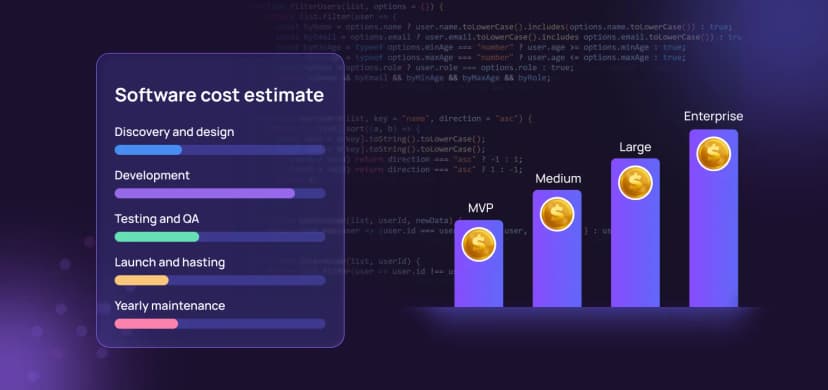
Many buyers think design takes most of the budget. The data says otherwise. Development, front end and back end combined, usually takes 50% to 70% of the total.

Notice how small discovery and project management are, at 5% to 10% each. The survey itself calls this “often too lean”. Skimping on planning is the most common way to pay more later through scope changes.
| Tip
Pay for discovery. A short paid planning phase should give you a clear scope, a recommended technical approach and a timeline. It is the cheapest insurance you can buy against a budget blow-out. |

Read the chart like this. For Laravel, 43% of firms put typical projects in the $3K to $10K band and only 12% in the $40K to $120K band. For ASP.NET and Spring Boot, 36% and 34% of firms reach that top band. That does not mean one tool is “better”. It reflects the type of work each is usually chosen for, especially large enterprise systems.
On the front end, React and Next.js projects most often land in the $10K to $40K band, while Angular tips higher: 28% of firms place typical Angular projects at $40K to $120K, reflecting enterprise use.
The lesson: pick the stack that fits your product and hiring plans, not the cheapest one. A well-supported choice makes it easier to find developers later. Our post on the benefits of TypeScript shows one way a stack choice improves long-term quality.

Hourly rates drive the price of any time-based quote. The survey found a clear split by geography.

About 57% of firms charge $50 to $100 an hour, which is the global mid-market. Around 30% charge $10 to $15, almost all in South and Southeast Asia. Only about 11% charge $100 to $150, and 2% go above $200.
Be careful not to judge by rate alone. A $15-an-hour team that needs twice as many hours, or fixes the same bug three times, is not cheaper than a $60-an-hour team that gets it right once. Compare the total for the same scope, and look at quality, communication and time zone too.

Fixed price
One agreed price for a defined scope. It suits clear, stable projects. The risk is that any change needs a new agreement.
Time and material
You pay for hours worked. It is flexible and fits projects that will change, but it needs active oversight.
Hybrid
Fixed price for clear phases such as design and first build, then hourly or retainer for the rest. Over half of firms (55.3%) offer it, and it is often the best balance.
Monthly retainer or dedicated team
A recurring fee for ongoing work. This suits products that keep evolving. Read our comparison of dedicated teams vs project-based hiring and see how our dedicated team service works. For wider hiring choices, see dedicated developer vs freelancer vs agency.
The survey’s most consistent finding is that the first invoice is only part of the cost. GoodFirms reports that the total two-year cost of a professionally built site typically runs 150% to 200% of the initial build invoice once hosting, maintenance, content, integration upkeep, and new features are included.

Maintenance. The survey advises budgeting about 15% to 20% of the build cost every year. See our guide on long-term maintenance.
Hosting and cloud. Servers, storage and backups grow with your users. Read about AWS and cloud infrastructure for scaling.
Integration upkeep. Other systems change their rules, and your app has to keep up.
Content and data. Missing text, images or product data delay launches more than technical work does.
SEO and analytics. These are build-time decisions. Adding them later costs more.
Compliance work. Accessibility and privacy rules are often pushed to “phase 2” and cost more to bolt on.
AI running costs. AI features create monthly usage bills that grow with your users.
| Did you know?
A web development respondent in the survey described scope creep as turning a 20-page marketing site into a project twice the size. The firms with strong change-control processes handle this far better than those who treat early conversations as informal. |
You can narrow the range before you speak to any company. Follow these six steps.

What to put in your brief
If you are still testing an idea, start smaller. Our MVP development service is built for exactly that.
If you already have a web app, the survey offers a useful rule of thumb. When annual maintenance costs exceed about 30% of a rebuild estimate, or when the current setup can no longer support your business, a rebuild often gives better long-term value than continued repairs. If a past project went wrong, read our guide on why a website redesign failed and how to fix it.
Price is only one signal. A good web application development company should help you spend wisely. Use this checklist.
Choosing on price alone. The cheapest quote often leaves out testing, security or support. You pay for them later.
Skipping discovery. This is the single most reliable way to meet scope creep halfway through.
Adding AI to look modern. AI works best as one narrow, cost-capped feature. Added for show, it raises the bill without raising the value.
Forgetting content. Text, images and data must be ready on time, or the schedule slips.
Ignoring upkeep. A launch is not the end. Budget for care from day one.
Code and Core is an ISO 9001 certified studio with 30+ dedicated developers and clients in 25+ countries. Our web development team covers front-end, PHP back-end, Node.js and TypeScript work, along with custom software development and AWS and cloud. We offer flexible hiring from 40, 80, or 160 hours a month, work under an NDA when you need it, and follow a five-phase approach: discovery, design, development, deployment, and delivery. See more in our portfolio.
If you already have a quote, we are happy to review it with you.
Custom web application development cost is not a mystery. A small set of decisions sets it: how much custom back-end work you need, which integrations and AI features you add, how often the scope changes, and how well the project is planned.
Plan carefully, pay for discovery, build in phases, and budget for the years after launch. Do that, and the gap between three quotes will start to make sense.

Custom back-end development was the top cost driver, cited by 70% of surveyed firms, followed by AI and automation features at 51% and client revisions at 49%.
GoodFirms advises budgeting about 15% to 20% of the build cost per year. Over two years, the total cost often reaches 150% to 200% of the original build invoice.
Fixed price suits a well-defined scope. Hourly or hybrid models suit projects where requirements will change. About 66% of firms offer fixed pricing and 55% offer hybrid pricing.
Write a clear brief, limit revision rounds, start with must-have features, build in phases, and choose a team with itemized pricing.
Catch wind of the latest technologies, strategies, and information that are set to boost your business operation. We update frequently!