News & Articles 23.10.2026
 SpeedyGo: One plugin to make your WordPress website faster
 Corvexa: AI that turn more website visitors into qualified leads.


 Energy
 Oil and gas
 Transportation
 E-commerce
 Healthcare
 Real Estate
 Fintech
 Manufacturing
 Education
 Agriculture
 Travel
 Cyber Security
 Crypto
 Law and Order
 Entertainment
 Hospitality
 Logistics
 Non-profit
 Digital Industry
 Venture Capital

A Quick Guide on the Right Software Development Approach for Enterprises in 2023


 22/10/2026


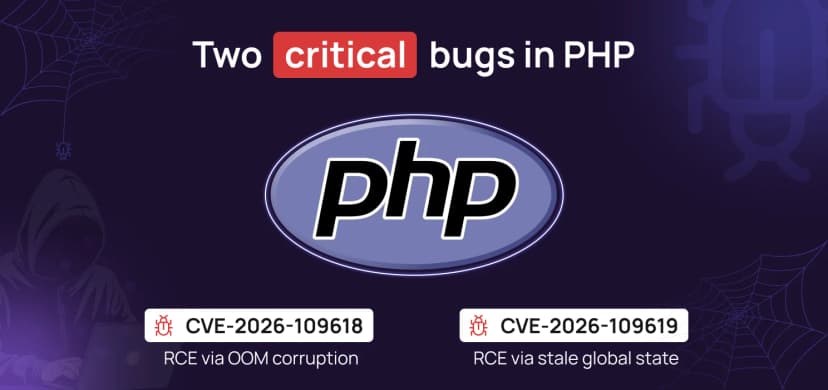
Two dangerous flaws in PHP let an attacker run their own commands on a web server without logging in. The details leaked a day before the planned release. Here is what happened, how the attack works, and what you should do.
Summary
|
PHP powers a very large part of the internet. According to W3Techs, about 69.3% of websites with a known server language use it. That includes WordPress, so millions of small business sites, blogs and online shops are involved.

Two critical PHP bugs leaked
It started with one post on Hacker News on 20 October at 15:20 UTC. The writer claimed two PHP bugs with the top danger score were about to be announced, and his only proof was a vague source. Security experts confirmed within hours that the bugs were real. By the next day, the FBI was telling companies to take servers offline if they could not update.

The original Hacker News post of 20 October 2026 that first warned about the two bugs. Source: news.ycombinator.com, item 50167754.
Post by the FBI Cyber Division (@FBICyberDiv) on X, 21 October 2026, advising organisations to take systems offline if they cannot update right away. Source: @FBICyberDiv on X.

Hacker News Post Claims PHP Vulnerabilities Without Verified Evidence

Post by the FBI Cyber Division (@FBICyberDiv) on X, 21 October 2026, advising organisations to take systems offline if they cannot update right away. Source: @FBICyberDiv on X.
A web server uses PHP workers. A worker takes a visitor’s request, builds the page, cleans up, and then waits for the next visitor. One worker handles many visitors one after another. Both bugs happen when this routine goes wrong.
PHP has a memory limit. When a request hits an error it cannot recover from, PHP stops that job at once and jumps out. Researchers found that PHP does not always tidy up properly when it does this. Some leftover data stays behind, and the next request can use it. Attackers can shape that leftover data to take control.
When a request uses up all of PHP’s memory at exactly the wrong moment, PHP stops halfway through setting something up. Later, the cleanup step reads that half-finished data as if it were fine. Researchers found several ways to cause this reliably. It was reported by Calif, Wiz, OpenAI, and Quarkslab.
When PHP hits a fatal error, it also stops the job suddenly. Some internal pointers still point at memory that has already been released. A later request can then use this invalid information. It was reported by Wiz, Calif, and OpenAI.

PHP Critical Vulnerabilities and High Risk for Apache mod_php

PHP Vulnerabilities Affect Versions Dating Back to PHP 5.4
| PHP branch | Fixed version |
| 8.5 | 8.5.12 |
| 8.4 | 8.4.27 |
| 8.3 | 8.3.36 |
| 8.2 | 8.2.35 |
Fixed versions. See the official PHP changelog for the final list.
Not sure if your website is affected?
If you do not know which PHP version your site runs, the team at Code and Core can check your hosting or server setup, tell you whether you are exposed, and plan the update with you. PHP backend development and looking after existing projects are core services at Code and Core.
Contact Code and Core and tell us about your setup. We will help you from there.
The key point is that the weakness is in PHP, not in the website’s own code. Imperva’s researchers say even a page that only prints “OK” can be affected, because the risky work happens before any website code runs.
The main trigger is a PHP feature called session upload progress. It tracks file uploads while PHP reads the upload request. An attacker can send a specially built upload request that makes PHP run out of memory in the middle of this work. This leaves messy leftover data behind.
Good news: it is not easy
Imperva points out that the attack is hard to finish. Causing the problem is simple, but turning it into running commands is not. The attacker’s later request must reach the same worker and place carefully shaped data in just the right spot. If the timing is off, the worker usually just crashes or answers normally. That does not make the bugs safe to ignore, because skilled attackers can repeat the attempt.
Imperva describes five different ways to abuse these flaws. Three of them use the upload progress feature as the trigger.
Put together, these show how invalid leftover data can lead to full remote code execution, not just crashes or leaks.
The weakness is old. Calif traces the first memory-limit bug of this kind in PHP back to 2004. The PHP Foundation says an outside audit in 2024 gave one of its developers early signs of this same problem, but nobody could show a real attack, so the fix stalled. The foundation calls that delay a structural failure.
AI changed the picture in 2026. On 11 August, Ryan Austin at Calif reported a working remote code execution, and OpenAI reported the same root cause on the same day. OpenAI says Calif found it using GPT-5.6 Soul through its Patch the Planet programme. Wiz sent more attack routes on 24 August, using Wiz Atlas, Gemini 4 Argon and GPT-5.6 Soul. A Wiz researcher wrote on X that, as expected in 2026, AI did most of the work.

AI-Assisted Research Uncovers Critical PHP Security Vulnerabilities
The PHP Foundation also says its security team has published 15 CVEs since 1 July and checked more than 100 other reports that were invalid, duplicates, or could not be reproduced.
PHP planned a calm release on 22 October. The leak changed that. All times are UTC.
PHP planned a calm release on 22 October. The leak changed that. All times are UTC.

Hacker News Post Contains Incorrect Dates, CVSS Scores and Missing Technical Details

Hacker News Source Admits to Misleading the Poster About Coordinated Disclosure

Kevin Beaumont Reports Leaked PHP Zero-Day Vulnerabilities

WatchTowr Confirms PHP Zero-Day Vulnerabilities and Warns of Early Disclosure

Official PHP Announcement of an Upcoming Critical Security Release

PHP Security Release Rescheduled to 21 October 2026

PHP Foundation Announces Security Release Reaching 5.4 Million Views

Calf Accidentally Publishes PHP Vulnerability Proof-of-Concept Video

Cloudflare Deploys Emergency WAF Rules Ahead of PHP Vulnerability Disclosure

Chainguard Breaks PHP Security Embargo by Publishing Patched Builds Early

Some organisations acted before the release. The German host Uberspace switched PHP off on all its servers. International Cyber Digest reported that a Dutch platform serving more than 100 local governments took council websites offline.

UberSpace temporarily took all servers offline due to a PHP security vulnerability, highlighting the importance of server security and timely software updates.

Attackers are exploiting PHP vulnerabilities before patches are released, forcing websites offline.
It depends on who you ask.

Cloudflare blocks early PHP attacks with temporary WAF rules until an official patch is released.

Patchstack detected probing attacks, with no confirmed breaches yet
Why stay careful
Earlier PHP bugs were abused soon after they became public. CVE-2024-4577 and CVE-2019-11043 are both on CISA’s known exploited list, and CISA says both were used in ransomware attacks.
Worried your site may already have been probed?
We can go through your server logs for the warning signs listed later in this post, such as PHP out-of-memory errors and unusual upload requests. If we find anything, we will help you clean up and secure the site.
Contact us and tell us about your setup. We will help you from there.
On shared hosting, you cannot update PHP yourself. PHP core developer Gina Peter Banyard wrote on Mastodon that hosting companies should be the ones handling this. WordPress said the same: no WordPress update is needed, and site owners should confirm their host’s plan.

WordPress security updates start with your hosting provider.

Two critical PHP vulnerabilities fixed, check your hosting provider’s update plan.

Hostinger says no action is needed as it rolls out PHP security fixes across its servers.

Amazon and Hostinger lead in PHP hosting numbers, highlighting the scale of the security update.

SiteGround and DreamHost confirm PHP vulnerability protections are in place.


cPanel updates PHP security patches to fix critical vulnerabilities. Keep your servers secure!
A VPS is different. Hostinger’s own page says that on a regular VPS, the customer looks after everything, security updates included.

Running a VPS or your own server?
The update is your job, and it can feel risky when a live site depends on it. At Code and Core, we can update PHP for you, test that your site still works afterwards, and set up regular maintenance so the next security fix does not catch you off guard.
Contact Code and Core and tell us about your setup. We will help you from there.

Hostinger now supports PHP 8.2–8.5! Upgrade for better security.

PHP 8.1 release date and version information.

Check your PHP version in WordPress Site Health settings.

Patched PHP versions and why WordPress, Laravel, or plugins alone cannot fix the vulnerability.

Cloudflare’s CEO called it a strong Band-Aid, not a cure.
Imperva suggests these short-term measures. They reduce risk but are not a complete fix for either bug. Test them first, because they can affect your site’s speed and features.
If you think you were attacked, check for code execution as well as stolen data. Look for unexpected child processes, changed application files, new ways for the attacker to return, unusual outgoing connections, and passwords that may have been exposed.
Need help with any of this?
If you are dealing with this problem and are not sure how to check your PHP version, cannot update your server yourself, or want your site checked for signs of an attack, please contact us at Code and Core. We will look at your setup and tell you clearly what to do next.
Contact Code and Core and tell us about your setup. We will help you from there.
| Protection from Imperva
Imperva says its web application firewall can block known exploit patterns as a virtual patch. Cloud WAF customers are covered automatically. Elastic WAF and WAF Gateway customers need a software update. A firewall helps, but patching PHP is still the real fix. |
| What the PHP Foundation says it is doing
It says it has added people and tools to its security team since May and is now giving priority to complex fixes so they are released faster. |
Sources
Imperva Threat Research, “PHP2Shell: When PHP Runs Out of Memory at the Wrong Moment”, 21 October 2026:Imperva blog
PHP changelog:php.net/ChangeLog-8.php
PHP supported versions:php.net/supported-versions.php
PHP usage share:W3Techs
Bug records:CVE-2026-109618,CVE-2026-109619
Known exploited list:CISA KEV catalog
Earlier exploited PHP bugs:CVE-2024-4577,CVE-2019-11043
Imperva WAF release notes:Gateway 14.7,Gateway 15.5,Elastic WAF 2.2.1
Hostinger statement:@hostinger on X
WordPress PHP version check:Site Health screen
Distribution advisories:Red Hat,Ubuntu


The reported fixed versions are PHP 8.5.12, 8.4.27, 8.3.36, and 8.2.35.
No. The vulnerabilities affect PHP itself. Updating WordPress or its plugins does not fix them.
Update PHP to a fixed version through your hosting provider or server package manager. Temporary security measures can reduce risk but do not replace patching.
Contact your hosting provider to confirm whether the PHP security patches have been applied. If you manage your own VPS, you are responsible for updating PHP.
A web application firewall may block known attack patterns, but it is only a temporary layer of protection. Updating PHP is the recommended fix.
Successful exploitation could let attackers run commands with the permissions of the PHP process, potentially exposing sensitive files, credentials, and website data.
Catch wind of the latest technologies, strategies, and information that are set to boost your business operation. We update frequently!