Development 16.09.2026
16.09.2026 SpeedyGo: One plugin to make your WordPress website faster
 Corvexa: AI that turn more website visitors into qualified leads.

 Energy
 Oil and gas
 Transportation
 E-commerce
 Healthcare
 Real Estate
 Fintech
 Manufacturing
 Education
 Agriculture
 Travel
 Cyber Security
 Crypto
 Law and Order
 Entertainment
 Hospitality
 Logistics
 Non-profit
 Digital Industry
 Venture Capital
A Quick Guide on the Right Software Development Approach for Enterprises in 2023


 16/09/2026


A website or web application can look perfect when it goes live, but that doesn’t mean it will remain problem-free forever.
As businesses add new features, update software, integrate third-party services, and make changes to their infrastructure, new issues can appear. A small bug can sometimes turn into a major problem that affects users, disrupts business operations, or even causes system downtime.
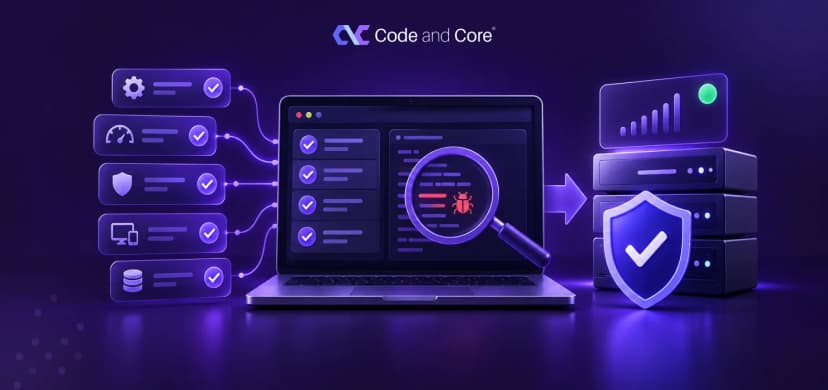
This is why regular QA audits are an important part of maintaining reliable digital products.
Quality assurance isn’t only about testing a website before launch. Ongoing QA audits help businesses identify potential problems, verify existing functionality, and ensure that new changes don’t negatively affect the rest of the system.
For businesses investing in a website design and development service, regular QA can help protect the performance and reliability of the final product.
A QA audit is a structured review of a website, web application, or software system to identify quality, functionality, performance, security, and usability issues.
Unlike one-time testing before launch, regular QA audits examine whether the system continues to work correctly as it changes.
Depending on the application, a QA audit may include:
The exact process depends on the complexity and requirements of the system.
One of the biggest benefits of regular QA audits is early problem detection.
A broken form, failed API request, or incorrect checkout calculation may not be noticed immediately by a development team.
Users, however, experience these issues directly.
Regular testing helps identify problems before they become widespread.
For example, a QA audit may discover that a payment form works correctly on desktop but fails on a particular mobile browser.
Finding the problem internally is much better than discovering it through customer complaints.
A regression bug occurs when a new change unintentionally breaks existing functionality.
This is common in applications that are regularly updated.
For example, a developer may add a new account feature that accidentally affects the existing login system.
Regression testing checks important existing functionality after changes are made.
Regular regression testing can therefore help ensure that:
New features don’t break old features.
Downtime can have serious consequences for businesses.
Depending on the application, downtime may result in:
QA audits can help identify potential failure points before they cause major disruptions.
They don’t guarantee zero downtime, but they can reduce avoidable failures by finding issues earlier.
A system can be technically functional while still performing poorly.
For example, a website may load correctly but take several seconds to become usable.
As content, users, and features increase, performance can gradually decline.
QA audits can evaluate:
Performance testing can help teams identify bottlenecks before they affect a larger number of users.
Users don’t all access websites in the same way.
They may use:
A feature that works perfectly in one environment may behave differently in another.
Regular compatibility testing helps ensure that important functionality continues to work across supported browsers and devices.
This is particularly important for e-commerce websites, customer portals, and applications with complex interactive features.
Modern websites rarely operate completely independently.
They may connect to:
Third-party services can change their APIs, authentication requirements, or functionality.
A change outside your application can sometimes affect your website.
Regular QA audits can verify that critical integrations are still functioning correctly.
QA audits can also support application security.
Security testing can help identify issues related to:
Security testing should be part of a broader security strategy rather than the only security measure.
Still, regular testing can help identify vulnerabilities that might otherwise remain unnoticed.
QA shouldn’t happen only at the end of a project.
A stronger approach is to include testing throughout development.
Developers and QA teams can test individual features as they are created.
The team can perform broader functional and regression testing.
Production monitoring and post-release testing can help identify unexpected problems.
Regular QA audits can ensure that updates, integrations, and changes haven’t introduced new issues.
This continuous approach is particularly useful for applications that receive frequent updates.

Manual Testing vs. Automated Testing
Both manual and automated testing have an important role.
Manual Testing
Human testers can evaluate areas that require judgment and real-world interaction.
For example:
Manual testing is particularly valuable when evaluating how an application feels to a real user.
Automated Testing
Automated tests can repeatedly check known functionality.
They can be useful for:
Automation can save time when the same tests need to be performed regularly.
The best QA strategy often combines both approaches.

How QA audits can reduce business costs
Fixing a problem early is usually easier than fixing it after it reaches production.
Imagine a small checkout bug is discovered during development. It may require a simple code change.
If the same problem reaches thousands of customers, the business may also need to deal with:
Regular QA helps shift the focus from reacting to problems to preventing problems.
A practical QA audit can include the following:
Check whether important features work according to requirements.
Verify that existing functionality continues working after updates.
Check how the application behaves under different workloads.
Test supported browsers, operating systems, and devices.
Review common security risks and access controls.
Verify that integrations and backend communication work correctly.
Identify confusing navigation, forms, or workflows.
Check whether the application can be used by people with different abilities.
The ideal frequency depends on the application.
QA audits may be appropriate:
High-traffic or business-critical applications may require more frequent testing.

Common QA mistakes
A website changes after launch, so QA shouldn’t stop at deployment.
Mobile and tablet users can encounter completely different problems.
New functionality can break existing features.
Automated testing is powerful, but it cannot replace every form of human testing.
Not every feature has the same business impact.
Testing should prioritize areas such as:
QA teams should document important test cases, known issues, and expected behavior.
This creates consistency across future testing cycles.

Code and Core
Code and Core
At Code and Core, we understand that quality needs to be considered throughout the entire development lifecycle.
Our team can integrate QA into website design and development services, helping businesses test websites and applications before and after launch.
Our QA and development capabilities include:
- Functional testing
- Regression testing
- API testing
- Cross-browser testing
- Mobile testing
- Performance testing
- Usability testing
- Security-focused testing
- Bug identification and fixing
- Ongoing maintenance
By combining development and quality assurance, we help businesses identify potential issues earlier and build digital products that are more reliable and easier to maintain.
Whether you’re launching a new website, upgrading an existing application, or maintaining a complex web platform, regular QA can become an important part of your long-term technology strategy.
System downtime is not always caused by major infrastructure failures.
Sometimes, it starts with something small, a broken API, failed update, database issue, compatibility problem, or feature that wasn’t properly tested.
Regular QA audits help businesses identify these problems before they become larger disruptions.
For companies investing in a website design and development service, QA should not be treated as the final step before launch. It should be an ongoing process that continues as the website or application evolves.
The goal isn’t simply to find bugs.
The goal is to build a system where problems are identified early, users experience fewer disruptions, and your digital product remains reliable as your business grows.
Catch wind of the latest technologies, strategies, and information that are set to boost your business operation. We update frequently!