Technologies 17.09.2026
17.09.2026 SpeedyGo: One plugin to make your WordPress website faster
 Corvexa: AI that turn more website visitors into qualified leads.

 Energy
 Oil and gas
 Transportation
 E-commerce
 Healthcare
 Real Estate
 Fintech
 Manufacturing
 Education
 Agriculture
 Travel
 Cyber Security
 Crypto
 Law and Order
 Entertainment
 Hospitality
 Logistics
 Non-profit
 Digital Industry
 Venture Capital
A Quick Guide on the Right Software Development Approach for Enterprises in 2023


 17/09/2026


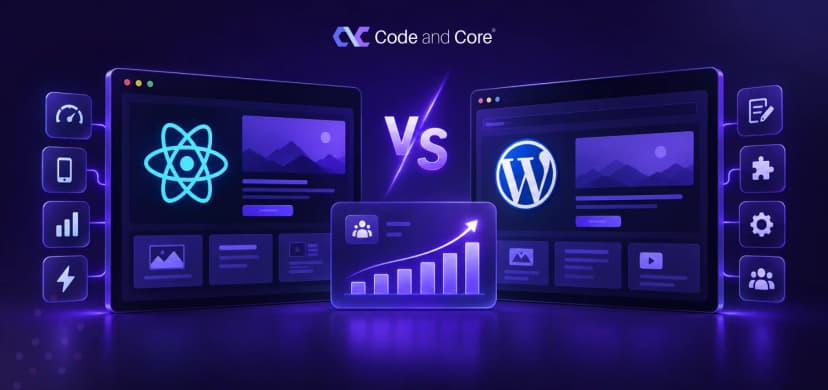
This blog breaks down the real difference between React and WordPress for business websites not which one is “better” in the abstract, but which one actually converts more visitors into leads and customers. You’ll get real 2026 performance data, a direct look at React vs WordPress conversion rate differences, guidance on the best CMS for lead generation, and a clear framework for choosing between a custom React site and a WordPress theme. There’s a comparison table, a practical example, and an FAQ section built to answer this exact decision.

What is the real difference between React and WordPress?
They’re not competing for the same job, which is why the debate gets confusing.
WordPress is a content management system. It runs on PHP, pulls content from a database on each request, and lets non-developers publish and edit pages through a dashboard. It currently powers roughly 41-43% of all websites globally, making it by far the most widely used platform on the web.
React is a JavaScript library for building interfaces, typically paired with a framework like Next.js for real websites. Instead of assembling a page from a database query every time someone visits, a well-built React site can pre-render pages ahead of time, serving static, fully built HTML instantly.
That architectural difference is the whole story behind React vs WordPress for business decisions. WordPress optimizes for editorial speed. React optimizes for delivery speed. Which one “wins” depends entirely on which speed your business actually needs more.

Does React vs WordPress conversion rate actually differ in practice?
Yes, and the gap is measurable rather than theoretical.
Surveys of WordPress sites typically show mobile PageSpeed scores in the 45–55 range, while well-built Next.js sites routinely score 90 or higher. That’s not a small difference; it’s often the gap between a site that struggles with Core Web Vitals and one that comfortably passes them.
Speed translates directly into conversions. Industry benchmark data shows mobile conversion rates already run at roughly half of desktop’s, around 2% versus 4%, and a slow-loading website widens that gap further. A 0.5% conversion rate improvement, which speed gains alone can deliver, is often enough to offset the cost of a full site migration within months at reasonable traffic levels.
To put a number on the underlying cause: Next.js sites deployed on modern edge infrastructure achieve a Time to First Byte around 50–80ms, while WordPress on managed hosting typically sees 100–200ms, and shared hosting can run 400–800ms. Every one of those milliseconds compounds into how long a visitor waits before they see anything at all, ll which is exactly what drives slow site speed to hurt Google rankings in the first place.


Is WordPress still a good choice for lead generation in 2026?
For a lot of businesses, yes, and it’s worth saying plainly, because the honest answer isn’t “always choose React.”
WordPress remains genuinely strong for content-driven sites, blogs, and marketing pages where publishing speed and non-technical editing matter more than shaving milliseconds off load time. If your team relies on the WordPress editor daily, and your current site’s PageSpeed scores and conversion rates are already reasonable, there’s no urgent case to rebuild.
The problems tend to surface as a site grows: plugin bloat piling up, page speed degrading, and critically, lead generation forms and CTAs loading slower as more plugins compete for the same resources. WordPress is also the most-attacked CMS by absolute volume, given both its market share and plugin attack surface, which is a real maintenance cost worth factoring in over time.
If you’re asking what’s the best CMS for lead generation specifically, the honest framework is: WordPress is fine until your traffic or conversion stakes are high enough that a 0.5–1 second speed difference starts costing more than the platform saves you in publishing convenience.
WordPress speed optimization plugins can also help businesses improve performance without immediately moving to a different architecture.
This is the practical decision most businesses are really trying to make, and it comes down to four factors rather than a blanket rule.
| Factor | WordPress theme | Custom React site |
| Time to launch | Fast days to a few weeks | Slower: weeks to a few months |
| Upfront cost | Lower | Higher |
| Mobile Core Web Vitals | Often 45–55 (plugin-dependent) | Routinely 90+ when built well |
| Content editing | Non-technical, built-in editor | Requires a headless CMS layer or developer support |
| Best fit | Content sites, blogs, standard marketing pages | Lead-gen sites, e-commerce, product-grade experiences at scale |
Notice the table isn’t declaring a universal winner;r it’s a diagnostic. A content-heavy site with a small team publishing daily will get more value from WordPress’s editing speed than from React’s rendering speed. A high-traffic lead-generation site where every fraction of a second of load time affects conversion volume will get more value from React’s performance ceiling.
There’s also a middle path worth knowing about: headless WordPress. This setup keeps the WordPress editor your content team already knows, but renders the actual front end in React or Next.,js, giving you editorial familiarity with performance closer to a custom build. It’s become one of the most common architectures chosen specifically to avoid an either-or decision.

How do you know which one is right for your business?
Start with a technical baseline rather than a gut feeling. Check your current mobile PageSpeed score, look at your Core Web Vitals report in Google Search Console, and count your active plugins. If your site is already scoring well and converting at a healthy rate, there’s no urgent case to migrate.
If you’re seeing high bounce rates, poor Core Web Vitals scores dragging down rankings, or conversion rates meaningfully below your industry’s benchmark, that’s usually the signal that the platform itself has become the bottleneck, not the content or the offer sitting on top of it.
A mid-sized B2B services company had a WordPress site with 40+ active plugins accumulated over several years:s a booking calendar, three different form builders, an SEO plugin, a chat widget, and various theme add-ons nobody remembered installing. Mobile PageSpeed sat at 38.
None of the content was the problem. The lead capture form itself took over four seconds to become interactive on mobile, and a meaningful share of visitors abandoned before it fully loaded.
Rebuilding the front end in Next.js while keeping WordPress as a headless content backend brought mobile PageSpeed to 92 and cut the form’s interactive time to under a second. Lead form completions rose by 22% over the following quarter with the exact same offer, the exact same copy, and the exact same traffic sources. The only variable that changed was how fast the page let visitors act.
Code and Core
At Code and Core, we help businesses choose and build the right web architecture based on their goals, traffic, content needs, and performance requirements. Whether you need a flexible WordPress website, a custom React or Next.js frontend, or a headless WordPress setup, our team can handle the design, development, optimization, and ongoing support. The focus is not simply on choosing newer technology, but on building a website that is fast, easy to manage, and designed to support real business growth.
Code and Core

Yes. Mobile PageSpeed scores for typical WordPress sites often sit in the 45–55 range, while well-built React/Next.js sites routinely score 90 or higher. Since mobile conversion rates already run at roughly half of desktop’s, and speed gains alone can lift conversion rates by 0.5% or more, the platform choice has a real, measurable effect on revenue.
There isn’t a single universal answer; it depends on your traffic and current performance. WordPress works well for lead generation at moderate scale, especially with a clean, well-maintained setup. For high-traffic sites where load-time fractions of a second measurably affect conversion volume, a custom React build or headless WordPress setup tends to outperform a standard WordPress theme.
Choose a WordPress theme if you need to launch quickly, have a non-technical team managing content, and your performance needs are standard. Choose a custom React site if you’re running a high-traffic, conversion-critical site, need product-grade interactivity, or have already hit a performance ceiling with WordPress that plugins can’t fix.
Yes,s this is called headless WordPress. It keeps the familiar WordPress content editor for your team while rendering the actual front end in React or Next.js, giving you editorial convenience with performance much closer to a fully custom build.
Check your mobile PageSpeed score, review your Core Web Vitals report in Google Search Console, and count your active plugins. If your scores are poor and your conversion rate sits below your industry’s benchmark, the platform itself not your content or offer is likely the bottleneck.
It costs more upfront than staying on a WordPress theme, but the calculation isn’t just migration cost versus zero. A relatively small conversion rate improvement, which speed gains alone often deliver, can offset the migration cost within months at sufficient traffic, ic making it a revenue decision as much as a technical one.
Catch wind of the latest technologies, strategies, and information that are set to boost your business operation. We update frequently!