Development 14.09.2026
14.09.2026 SpeedyGo: One plugin to make your WordPress website faster
 Corvexa: AI that turn more website visitors into qualified leads.

 Energy
 Oil and gas
 Transportation
 E-commerce
 Healthcare
 Real Estate
 Fintech
 Manufacturing
 Education
 Agriculture
 Travel
 Cyber Security
 Crypto
 Law and Order
 Entertainment
 Hospitality
 Logistics
 Non-profit
 Digital Industry
 Venture Capital
A Quick Guide on the Right Software Development Approach for Enterprises in 2023


 14/09/2026


A website or web application may look impressive on the frontend, but much of its functionality depends on what happens behind the scenes.
The backend manages data, authentication, business logic, APIs, databases, payments, user permissions, and communication between different systems. If the backend is poorly designed, even a visually excellent application can become slow, unreliable, or vulnerable to security problems.
PHP remains a widely used technology for backend development, powering websites, content management systems, e-commerce platforms, and custom web applications.
When PHP is combined with a well-planned architecture and modern development practices, it can provide a strong foundation for scalable web development solutions.
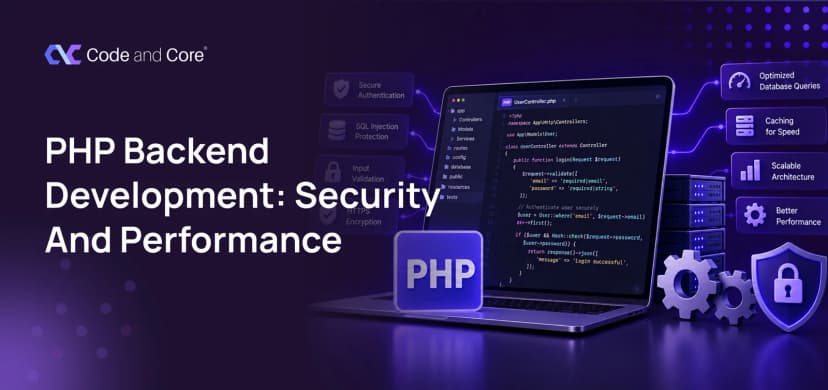
In this guide, we’ll explore how PHP backend development can be optimized for security and performance and what businesses should consider when building a PHP-based application.

What is PHP backend development ?
PHP is a server-side scripting language used to build dynamic websites and web applications.
Unlike frontend technologies that run primarily in the user’s browser, PHP executes on the server. It can process requests, communicate with databases, authenticate users, perform business logic, and return the appropriate response to the browser or application.
PHP can be used for:
Frameworks such as Laravel can further structure PHP applications and provide tools for routing, authentication, database management, validation, and other common backend requirements.
Backend security should be considered from the beginning of development.
A vulnerable backend can expose sensitive information, allow unauthorized access, or affect the availability of an entire application.
Security isn’t a single feature that can simply be switched on. It requires multiple layers of protection.

Secure authentication
Authentication determines whether a user is who they claim to be.
A secure PHP application should use appropriate authentication practices, including:
Passwords should never be stored as plain text.
PHP provides password hashing functions that allow developers to securely hash and verify passwords rather than storing the original password.

Protect against SQL injection
SQL injection occurs when attackers manipulate database queries through untrusted input.
For example, directly inserting user-provided data into SQL queries can create security vulnerabilities.
Prepared statements and parameterized queries are important ways to reduce this risk.
Modern PHP frameworks and database abstraction tools can also provide safer ways to interact with databases.
Developers should never assume that user input is trustworthy.

Validate and sanitize input
Applications receive information from many sources:
This data should be validated before it is processed.
Validation checks whether information matches the expected format, while sanitization can help remove or neutralize unwanted content when appropriate.
For example, an application might verify that an email field contains a valid email format before processing it.

Use HTTPS
HTTPS encrypts communication between users and the server.
This is particularly important when applications handle:
A properly configured HTTPS connection helps protect data while it travels between the user’s device and the server.

Implement proper authorization
Authentication answers:
Who are you?
Authorization answers:
What are you allowed to do?
These are different concepts.
A user may be authenticated but still shouldn’t have access to administrative functions.
PHP applications should use clearly defined roles and permissions to control access to sensitive functionality.
For example:
Each role should have only the permissions it actually requires.

Protect against cross-site scripting
Cross-site scripting, or XSS, can occur when untrusted content is inserted into web pages and interpreted as executable code.
Proper output encoding, input handling, content security policies, and framework security features can help reduce XSS risks.
Security should be considered wherever user-generated or external content is displayed.
Security is only one side of backend development.
Your application also needs to respond quickly and handle increasing traffic efficiently.
Here are several ways developers can improve PHP backend performance.

Optimize database queries
The database is often one of the most important performance factors in a web application.
Poorly written queries can create unnecessary processing and slow down the entire application.
Developers can improve database performance by:
A fast PHP application still needs a well-optimized database.

Use caching
Caching stores frequently used information so it doesn’t have to be generated repeatedly.
Different types of caching can be used at different levels:
For example, if a page displays information that changes infrequently, caching can reduce repeated database and processing operations.

Use PHP’s modern versions
Using an outdated version of PHP can create both security and performance problems.
Newer PHP versions generally include improvements to performance, security, language features, and compatibility.
Businesses should maintain a supported PHP version and test applications before upgrading.

Optimize application logic
Backend performance isn’t only about the database.
Poorly designed application logic can also create unnecessary processing.
Developers should identify:
Profiling tools can help identify where an application is spending most of its processing time.

Use asynchronous processing
Not every task needs to happen while the user waits for a response.
Some operations can be processed in the background.
For example:
Background jobs can help keep user-facing requests fast while longer operations are processed separately.

Optimize API responses
Modern applications frequently communicate with APIs.
Large API responses can increase network usage and processing time.
Developers can improve API performance by:
A well-designed API can improve both backend and frontend performance.

PHP frameworks and backend development
While PHP can be used directly, frameworks can help developers structure larger applications.
Laravel is one popular PHP framework that provides tools for:
Frameworks can reduce repetitive development work and encourage consistent application architecture.
However, simply using a framework doesn’t automatically make an application secure or fast. Developers still need to follow appropriate engineering and security practices.

Scalability in PHP applications
A backend should be designed with future growth in mind.
A small application may initially serve only a few hundred users. As the business grows, traffic and data requirements can increase significantly.
Scalable PHP applications can use techniques such as:
The right architecture depends on the application’s requirements and expected traffic.

Security and performance should work together
Security and performance shouldn’t be treated as completely separate goals.
For example, caching can improve performance, but sensitive information shouldn’t be cached carelessly.
Similarly, security checks are essential, but inefficient validation or authorization processes shouldn’t unnecessarily slow down every request.
Good backend architecture considers both.
The goal is to create an application that is:
Secure enough to protect data.
Fast enough to provide a smooth experience.
Flexible enough to support future growth.

Common PHP backend development mistakes
Running outdated PHP versions, frameworks, or dependencies can increase security and compatibility risks.
Never assume that information submitted by users is safe.
An inefficient database structure can create performance problems as the application grows.
Repeatedly generating the same data can waste server resources.
Users should only be able to access the functionality and information they are authorized to use.
Without monitoring, it can be difficult to understand where performance and reliability problems originate.
Security and performance problems are easier to fix before they reach production.

Choosing the right PHP development partner
Building a secure and high-performing PHP application requires more than knowledge of the programming language.
A development team should understand:
A professional development partner can evaluate your requirements and recommend an architecture that fits your business instead of applying the same solution to every project.

Why choose Code and Core for web development solutions
At Code and Core, we build custom backend systems designed around specific business requirements.
Our team works with PHP, Laravel, MySQL, APIs, cloud technologies, and modern frontend frameworks to create web applications that are secure, scalable, and maintainable.
Our web development solutions can support businesses with:
We focus on understanding your application requirements before selecting the appropriate architecture and technology stack.
Whether you are building a new application or improving an existing PHP system, our team can help strengthen its backend foundation and prepare it for future growth.

Final thoughts
PHP continues to be a practical technology for building modern backend systems. But the success of a PHP application depends on how it is designed, developed, secured, and maintained.
From secure authentication and input validation to database optimization, caching, and scalable architecture, every part of the backend contributes to the overall experience.
For businesses looking for reliable web development solutions, investing in a secure and performance-focused PHP backend can provide a strong foundation for long-term growth.
The goal isn’t simply to make your PHP application work.
The goal is to make it secure, fast, reliable, and ready for what comes next.
Catch wind of the latest technologies, strategies, and information that are set to boost your business operation. We update frequently!