Development 10.09.2026
10.09.2026 SpeedyGo: One plugin to make your WordPress website faster
 Corvexa: AI that turn more website visitors into qualified leads.

 Energy
 Oil and gas
 Transportation
 E-commerce
 Healthcare
 Real Estate
 Fintech
 Manufacturing
 Education
 Agriculture
 Travel
 Cyber Security
 Crypto
 Law and Order
 Entertainment
 Hospitality
 Logistics
 Non-profit
 Digital Industry
 Venture Capital
A Quick Guide on the Right Software Development Approach for Enterprises in 2023


 09/09/2026


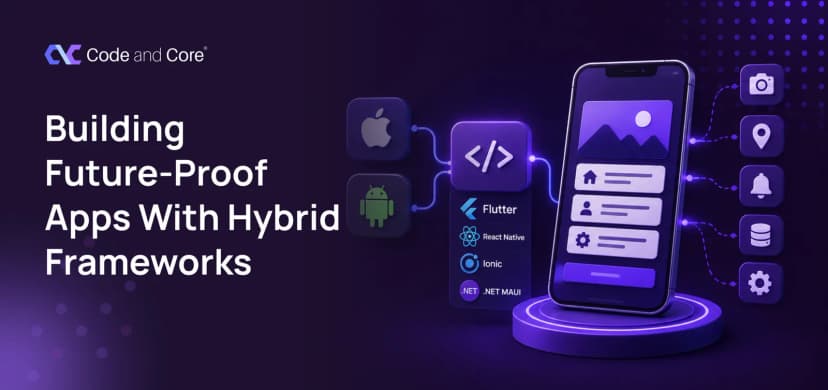
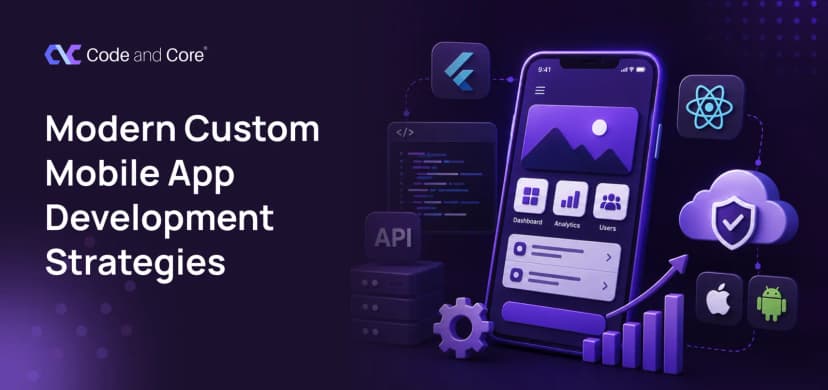
In this blog, we will explore how hybrid frameworks support custom mobile app development, their benefits, important considerations, and how businesses can use them to build future-ready applications.

What Are Hybrid App Frameworks
Hybrid app frameworks allow developers to create mobile applications using technologies that can work across different platforms.
Instead of developing two completely separate applications, developers can share a significant portion of the code between iOS and Android. The application can then access device features such as cameras, GPS, notifications, storage, and sensors through platform-specific integrations or plugins.
Popular frameworks and technologies include:
The right choice depends on the application’s requirements, performance expectations, development team’s expertise, and long-term goals.

Why Businesses Choose Hybrid Development
The biggest advantage of hybrid development is code reuse.
With a shared codebase, developers can reduce repetitive development work. Changes to common application features can often be implemented across platforms more efficiently.
For businesses, this can mean:
However, hybrid development is not simply about building one app instead of two. A successful application still needs thoughtful architecture, platform-specific testing, security planning, and ongoing optimization.

How Hybrid Frameworks Support Custom Mobile App Development
Every business has different requirements. A restaurant app, financial platform, healthcare application, and logistics solution will have completely different workflows.
This is why custom mobile app development is important. Businesses need applications designed around their users and processes rather than generic templates.
Hybrid frameworks can support custom development by allowing teams to build features specifically for the business while maintaining a shared technical foundation.
For example, a business could develop:
The framework provides the foundation, while developers customize the application according to business needs.

Faster Time to Market
Launching an app quickly can be important, especially for startups and businesses testing a new product idea.
Developing shared functionality across platforms can reduce duplicated development work. Teams can focus more of their time on the product itself instead of maintaining completely separate codebases.
This can be particularly useful for MVP development.
A business can launch an initial version, collect user feedback, identify important features, and continue improving the application based on real-world usage.

Easier maintenance
Maintaining two separate applications can become challenging as the product grows.
A bug discovered in a common feature may require changes and testing across multiple codebases.
With hybrid development, much of the shared functionality can be maintained from one codebase. This does not eliminate platform-specific maintenance, but it can simplify the overall process.
For growing businesses, easier maintenance can translate into more predictable development cycles.

Consistent user experience
Users expect an application to feel familiar regardless of whether they are using an iPhone or Android device.
Hybrid development can help teams maintain consistent:
At the same time, developers can still introduce platform-specific behavior where it improves usability.
The goal should not be to make iOS and Android look completely identical. Instead, the experience should feel consistent while respecting the conventions of each platform.

Easier scaling
A future-proof application should be able to grow with the business.
Your first version may have only a few features. Over time, you may need additional integrations, user roles, analytics, payment options, or automation.
A well-structured hybrid application can provide a foundation for this growth.
However, scalability depends more on the application’s architecture than the framework alone. Developers need to plan APIs, databases, authentication, state management, and infrastructure carefully from the beginning.

Access to native features
Modern hybrid frameworks are capable of working with many native mobile features.
Depending on the framework and project requirements, developers can integrate:
When a feature requires deeper native functionality, developers can also use native modules or platform-specific code.
This gives businesses flexibility without requiring the entire application to be built separately for each platform.
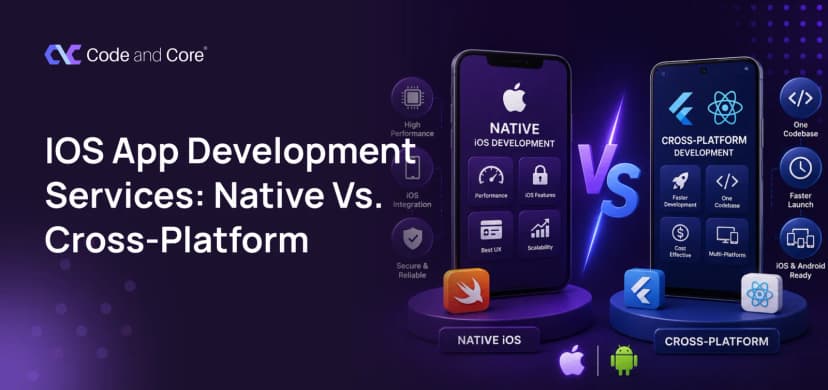
Hybrid development is not automatically better than native development. The right approach depends on the project.
Native development can be ideal when an application requires highly optimized platform-specific performance, advanced device functionality, or a deeply customized experience.
Hybrid development can be a strong choice when businesses want to launch across multiple platforms efficiently while sharing a significant amount of code.
A simple comparison looks like this:
| Factor | Hybrid | Native |
| Code reuse | High | Low |
| Multi-platform development | Efficient | Separate development |
| Development time | Often faster | Usually longer |
| Maintenance | Simplified | Separate codebases |
| Platform-specific optimization | Good | Excellent |
| Cost efficiency | Often higher | Can require more resources |
The decision should always be based on the application’s actual requirements rather than choosing a framework simply because it is popular.
Choosing a hybrid framework alone does not make an application future-proof.
A future-ready app requires a strong foundation.
The application’s architecture should allow new features and integrations to be added without rewriting major parts of the system.
A well-designed backend and API layer makes it easier to connect the application with other services and future platforms.
Authentication, authorization, encryption, secure API communication, and safe data storage should be considered from the beginning.
Users expect apps to open quickly and respond smoothly. Developers should optimize application assets, API requests, images, caching, and rendering.
Testing across different devices and operating system versions can help identify problems before they reach users.
Mobile operating systems, security standards, and device capabilities continue to change. Applications need regular updates to remain compatible and secure.
Hybrid development can provide significant benefits, but poor implementation can create problems.Some common mistakes include:
Choosing a framework only because it is trending:
The framework should match the project’s requirements.
Ignoring native platform differences:
iOS and Android have different design patterns and behaviors. These differences should be considered.
Using too many third-party plugins:
Poorly maintained dependencies can create security, compatibility, and performance issues.
Treating performance as an afterthought:
Performance should be considered during architecture and development, not only after launch.
Skipping real-device testing:
An application that works perfectly in an emulator may behave differently on actual devices.
Building a future-proof application requires more than selecting a framework. Businesses also need support with product planning, UX/UI design, development, testing, deployment, and maintenance.
A professional custom mobile app development team can help businesses evaluate their requirements and choose an appropriate technology stack.
The process typically includes:
This approach helps ensure that the application is designed not only for today’s requirements but also for future business growth.
Why choose Code and Core
At Code and Core, we understand that building a mobile app is not just about writing code. It is about creating a product that works smoothly today and can grow with your business tomorrow.
Our team focuses on developing custom mobile app development solutions based on your business goals, target users, and technical requirements. Whether you need a new MVP, a customer-facing application, or a scalable business app, we help you choose the right technology and development approach.
From UI/UX design and app development to API integration, testing, deployment, and ongoing maintenance, we can support the complete development journey.
With the right strategy and technology, we help businesses build mobile applications that are scalable, user-friendly, secure, and ready for future growth.
Hybrid frameworks have changed how businesses approach mobile application development. By allowing teams to reuse code across platforms, they can make development more efficient while still creating feature-rich mobile experiences.
But the framework is only one part of the equation.
A truly future-proof application needs scalable architecture, strong security, reliable performance, thoughtful UX, regular testing, and continuous maintenance.
For businesses looking to build an application for both iOS and Android, custom mobile app development using a suitable hybrid framework can be a practical way to balance performance, flexibility, development time, and long-term scalability.
The best technology choice is ultimately the one that supports your users, business goals, and future product roadmap.
Catch wind of the latest technologies, strategies, and information that are set to boost your business operation. We update frequently!