Development 19.10.2026
19.10.2026 SpeedyGo: One plugin to make your WordPress website faster
 Corvexa: AI that turn more website visitors into qualified leads.

 Energy
 Oil and gas
 Transportation
 E-commerce
 Healthcare
 Real Estate
 Fintech
 Manufacturing
 Education
 Agriculture
 Travel
 Cyber Security
 Crypto
 Law and Order
 Entertainment
 Hospitality
 Logistics
 Non-profit
 Digital Industry
 Venture Capital
A Quick Guide on the Right Software Development Approach for Enterprises in 2023


 25/08/2026


In this guide, you will understand what bespoke web development actually means, how it compares with templates, where each approach works best, how they differ in cost, performance, SEO, flexibility, scalability, and maintenance, and, most importantly, how to decide which one makes sense for your business.
Because the answer is not simply “custom is better.”
The better question is: Does your website need to fit your business, or can your business comfortably fit the website you are buying?

Bespoke web development means creating a website specifically around your business, users, goals and technical requirements. Instead of starting with a fixed design and changing your content to fit it, the process starts with understanding what the website needs to achieve.
That could mean designing:
The design, functionality, and technical architecture can be created around those requirements.
Think of it like buying clothes.
A template is like buying something ready-made from a store. You choose your size and make small adjustments.
Bespoke development is like having something tailored specifically for you.
Both can work.
The question is whether the extra flexibility is worth the investment.

A ready-made template is a pre-designed website structure created for general use.
You may get:
You then add your own: Logo + colours + images + content + branding
Platforms such as WordPress, Wix, Shopify and Squarespace offer large libraries of templates and themes. Current website-builder comparisons also show that ready-made platforms continue to offer increasingly sophisticated design, ecommerce and integration capabilities. (TechRadar)
And that is important. Templates are not automatically bad. For many businesses, they are a practical and cost-effective starting point.

The biggest reason is simple: They are faster.
You do not have to design every section from scratch.
You do not have to develop every basic feature.
You can start with something that already works and customise it.
Templates can make sense when:
If your requirement is simply: “We need a professional five-page website” there may be little reason to build everything from scratch.

The reason is not simply aesthetics. It is control.
With bespoke web development, you have greater control over:
Instead of asking: “Can this template do what we need?” you can ask: “What should the website do?” That change in thinking is important.
| Factor | Bespoke web development | Ready-made template |
| Design | Built specifically for you | Pre-designed |
| Launch speed | Usually slower | Usually faster |
| Initial investment | Higher | Lower |
| Flexibility | Very high | Limited to platform/theme |
| Unique functionality | Strong | Depends on available features |
| Integrations | Highly flexible | Depends on plugins/apps |
| Scalability | Designed around requirements | Depends on platform |
| Branding | Highly distinctive | Can be customised |
| Maintenance | Requires technical support | Often easier initially |
| Long-term control | High | Can depend on platform |
| Best for | Complex or strategic websites | Standard websites |
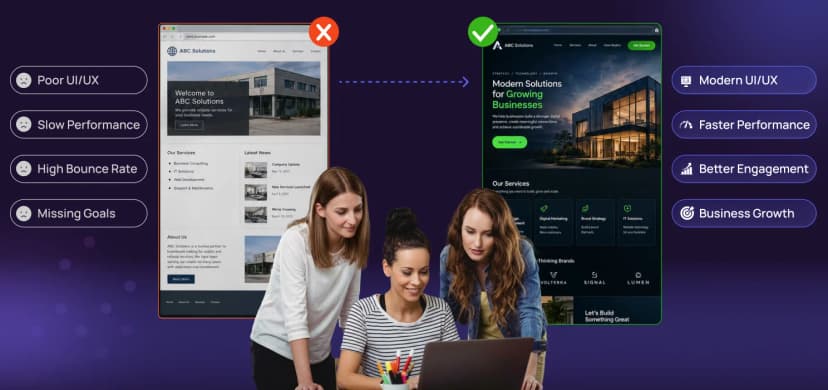
Your website is often the first substantial interaction someone has with your business. That means design is not only about making the homepage look attractive.
It is about:
Templates: Templates provide proven layouts. That can be an advantage. You do not have to wonder where a navigation menu should go or how a standard contact page should look. But the same advantage can become a limitation when your business needs something different. Another company may use the same theme. Then another. And another. You can customise colours and images, but the underlying structure may still feel familiar.
Bespoke development; With a bespoke approach, the experience can be designed around your audience. For example, if your primary goal is lead generation, the website can be structured around the journey from: Search → Information → Trust → Proof → Action
If your website is a customer portal, the priority may instead be: Login → Dashboard → Tasks → Information → Support. The design follows the user journey rather than forcing the journey into a template.

This is where the difference becomes much clearer.
Imagine a company that needs customers to:
A basic template may handle some of these requirements. But once multiple workflows need to work together, you may start adding plugins, extensions, custom code and third-party tools. Eventually, you may be building a custom system on top of a system that was never designed for your workflow.
Bespoke development
A bespoke solution can design the entire workflow from the beginning. That does not necessarily mean rebuilding every component. It means the architecture can be planned around the actual requirements.

Modern businesses rarely operate through one software system.
You might use:
A website often needs to communicate with several of them.
With a template
You may depend on an existing plugin or integration. If the integration exists and works well, great. But if it does not, you may need workarounds.
With bespoke development
The development team can create APIs and integrations around your requirements. For example: Website → API → CRM → Sales team
A visitor submits a form. The lead automatically enters the CRM. The sales team receives the required information. No one has to copy and paste the data manually. That is where custom development can create value beyond design.

This is where you should be careful. You will often hear: “Custom websites are always faster.” That is not automatically true. A poorly developed custom website can be slow. A well-built template website can be fast. Performance depends on implementation. However, bespoke development gives developers more control over what is included and how the website is structured. Templates can come with features, scripts, plugins and components that you may not actually need. The important thing is not whether the website is custom. It is whether it is properly engineered.
Google recommends paying attention to Core Web Vitals, which measure loading performance, responsiveness and visual stability. Its current guidance recommends aiming for an LCP of 2.5 seconds or less, INP below 200 milliseconds, and CLS below 0.1 for a good user experience. (Google for Developers)
So instead of asking: “Is custom faster?”
ask: “Has performance been considered from the beginning?”

Another common misconception is: “Custom websites automatically rank higher.”
They do not. Google does not reward a website simply because it was custom-built.
Search performance depends on many things, including:
Google specifically recommends considering the overall page experience rather than focusing on one metric alone. (Google for Developers)
Your website should communicate what makes your business different. Templates provide a starting point, but they can create visual similarities between businesses.
Bespoke design allows you to control:
This does not mean a template cannot look professional. It means bespoke development gives you greater control over the experience.
At first, templates can feel easier. You can update content through the CMS. You can install plugins. You can change layouts. But plugins and themes also need maintenance. Updates can sometimes create compatibility issues. A plugin may stop being supported. A third-party integration may change. Security vulnerabilities may require immediate attention.
Bespoke websites: Custom websites also need maintenance. The difference is that you generally have greater control over the underlying code and architecture. The key is having a reliable development partner who understands the system.

A template is probably the better option if:
You have a simple website requirement
You mainly need pages such as:
Your budget is limited
You want to establish an online presence without a large initial investment.
You need to launch quickly
Your priority is getting online as soon as possible.
Your functionality is standard
You do not need unusual workflows or complex integrations.
You are testing an idea
A template can help you validate your business before investing heavily in technology.
Bespoke development becomes more attractive when:

There is actually a third option that many businesses overlook. You do not always have to choose between: 100% template and 100% custom. You can combine the two. For example: Existing CMS + custom design + custom components + selected integrations. This can provide a balance between speed, flexibility and cost. A hybrid approach can be useful when you want the convenience of an established platform but still need certain parts of the experience to be unique.
Still unsure? Ask these five questions.
Question 1: Are our requirements standard? If yes, start by considering a template. If no, explore bespoke development.
Question 2: Do we need unique functionality? If users need to complete unusual workflows, bespoke development becomes more valuable.
Question 3: How important is the website to our business? If it is simply an online brochure, a template may be enough. If it drives leads, sales, customer service or operations, the decision deserves more attention.
Question 4: Are we expecting significant growth? If yes, consider scalability before choosing your platform.
Question 5: Are we trying to save money now or create flexibility for later? Both are valid goals. You simply need to know which one matters more at your current stage.

Before choosing a development approach, ask the development company:
“What would you recommend for our actual requirements?” A good agency should not automatically push you toward the most expensive option.
“What happens if we need new features later?” You want to understand how flexible the solution will be.
“How will you approach performance?” Ask how speed, caching, images, scripts and infrastructure will be handled.
“How will SEO be considered?” SEO should not be something added after development.
“What integrations can you support?” If your website needs to communicate with other platforms, discuss this early.
“What happens after launch?” Understand maintenance, support, updates and future development.

How Code and Core can help
At Code and Core, web development can be approached according to what your business actually needs rather than forcing every project into the same structure.
Whether the requirement is a custom website, ecommerce platform, SaaS application, CRM, ERP, WordPress solution or web application, the process can bring together UX/UI design, development, integrations, performance and ongoing support.
The technology can be selected according to the project, with experience across technologies such as React, Next.js, PHP, Laravel, Node.js, Python, MySQL, MongoDB and AWS.
The goal is not to make every website bespoke.
It is to understand when bespoke development creates meaningful value and when a simpler solution is the smarter choice.
The debate between bespoke web development and ready-made templates should not be about which one is universally better. It should be about fit. A template can be the right choice when you need something simple, affordable and fast. Bespoke development can be the better choice when your website needs unique functionality, complex integrations, a distinctive user experience, or room to grow. And sometimes, the smartest option is somewhere in between. The important thing is to make the decision based on your business—not on the idea that “custom is premium” or “templates are cheap.” Before choosing, ask yourself:
What does my website need to accomplish?
Who will use it?
How complicated is the user journey?
What systems need to connect to it?
Where will the business be in three years?
Once you answer those questions, the right development approach becomes much easier to see. Because a good website is not defined by whether it uses a template or custom code. It is defined by how well it solves the problem it was built to solve.
If you are unsure whether your project needs a ready-made template, a hybrid solution, or bespoke web development, Code and Core can help you evaluate the requirements before you invest in development. Tell us what you want your website to achieve, and let’s find the right way to build it.
Catch wind of the latest technologies, strategies, and information that are set to boost your business operation. We update frequently!