News & Articles 23.10.2026
23.10.2026 SpeedyGo: One plugin to make your WordPress website faster
 Corvexa: AI that turn more website visitors into qualified leads.
 Energy
 Oil and gas
 Transportation
 E-commerce
 Healthcare
 Real Estate
 Fintech
 Manufacturing
 Education
 Agriculture
 Travel
 Cyber Security
 Crypto
 Law and Order
 Entertainment
 Hospitality
 Logistics
 Non-profit
 Digital Industry
 Venture Capital
A Quick Guide on the Right Software Development Approach for Enterprises in 2023

 07/09/2026


In this guide, we will look at how startups can plan an MVP, decide which features matter, speed up development, avoid common mistakes, and use custom app development strategically to turn an idea into a real product.

What is an MVP
MVP stands for Minimum Viable Product. It is the first usable version of a product that contains enough functionality to solve its core problem and learn from real users.
It does not mean: “Build a poor-quality app.”
It means: “Build only what is necessary to test the idea.”
For example, imagine you want to build a food delivery platform.
Your long-term product might include:
But your MVP might only need:
Browse → Select food → Order → Pay → Track order
The additional features can come after you understand what users actually need.
The biggest advantage is learning earlier. Without an MVP, a startup can spend months developing a product based on assumptions.
Then launch it and discover:
Users do not understand the product.
The main feature is not useful.
The pricing does not work.
People want something completely different.
An MVP allows you to test these assumptions before investing heavily in the full product.
Suppose you have 15 planned features. After talking to potential users, you discover that only four are essential to solving the main problem.
Why spend months building the other 11? MVP development helps you focus your time and budget on what matters most.

Start with one clear problem
Before writing requirements, complete this sentence: “Our product helps [specific user] solve [specific problem] by [specific solution].”
For example: “Our app helps small retailers manage customer orders from one place instead of tracking them manually through messages and spreadsheets.”
That statement gives your team direction.
If a feature does not help solve that problem, question whether it belongs in the MVP.

Define the core user journey
Your MVP should have a clear path from the user’s first interaction to the value they are looking for.
For example:
Download app → Create account → Search → Select → Purchase → Confirmation
Now examine every step.
Ask:
The simpler the core journey, the faster you can usually build and test the product.

Separate must-have and nice-to-have features
Create two lists.
These are required for the product to work.
For example:
These can wait.
For example:
This simple exercise can dramatically reduce the initial scope.

Do not confuse MVP with a prototype
A prototype shows how an idea might work. An MVP is an actual usable product. A prototype might contain clickable screens without a real backend. An MVP should allow users to perform the core action.
For example:
Prototype: User clicks “Book Now” and sees a confirmation screen.
MVP: User actually books an appointment and receives confirmation. Both are useful, but they serve different purposes.

Choose technology based on the product
Technology should support your MVP not become the focus of it.
Depending on your requirements, you might choose:
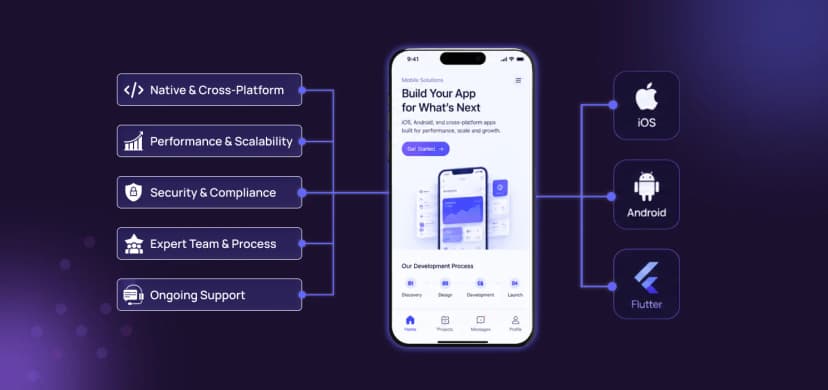
For a startup launching on both iOS and Android, cross-platform development can sometimes help reduce duplicated development work.
For an application requiring deep platform-specific functionality, native development may be more appropriate.
The right choice depends on the product.

Design before development
You do not need a hundred beautifully designed screens before writing code. But you should understand the core experience.
Start with: User flows → Wireframes → UI design → Development
This helps identify confusing journeys before developers spend time implementing them.
A simple wireframe can reveal a problem that would otherwise become an expensive development change later.

Build with scalability in mind but don’t overbuild
Startups often make one of two mistakes. They either build without thinking about growth at all.
Or they spend months creating an enterprise-level architecture for a product that has not found its first customers.
The better approach is somewhere in the middle.
Build a solid foundation that can handle your expected early users while keeping the architecture flexible enough to evolve. You do not need to solve every future problem today.

Use APIs and third-party services wisely
You do not have to build everything yourself.
Your MVP might use existing services for:
This can reduce development time. However, third-party services should be evaluated carefully.
Consider:
Cost
Security
Reliability
API limitations
Vendor dependency
A shortcut is useful only when it does not create a larger problem later.

Test while you build
Do not wait until the entire MVP is finished to start testing.
Test important functionality throughout development.
Check:
Early testing makes problems cheaper to fix.

Launch with real users
An MVP is valuable because it creates a feedback loop.
The cycle looks like this: Build → Launch → Measure → Learn → Improve
Once users start interacting with the product, you can discover:
This information is often more valuable than assumptions made inside a meeting room.

Measure the right things
Downloads are not enough.
Depending on the product, track metrics such as:
For example, if 10,000 people download your app but only 300 complete the core action, the download number is not telling the full story.
Focus on the behaviour that proves whether the product is creating value.

How custom app development can support an MVP
Custom app development can be useful when your startup has a product concept that does not fit neatly into an existing platform.
A custom development team can help with:
The goal should not be to build the biggest possible product.
It should be to build the right first version.

How Code and Core can help
How Code and Core can help
At Code and Core, we approach custom app development around the product’s actual requirements.
That can mean helping you move from:
Idea → User flow → MVP → Launch → Feedback → Scale
Instead of building every feature at once, the development process can focus on validating the core idea first and then expanding the product based on real-world learning.
This approach can help startups make better decisions about where to invest development time and resources.
Launching quickly does not mean rushing blindly. A successful MVP is about focused development. You identify the problem. You understand the user. You choose the essential features. You design the core journey. You build a reliable first version. Then you launch, measure, and learn. The most important question is not: “How quickly can we build the entire app?”
It is: “How quickly can we build enough of the right product to learn whether people want it?”
That shift in thinking can save startups significant time, development effort, and unnecessary spending.
And once the product proves its value, you have something far more useful than an idea, you have a foundation you can confidently build on.
Code and Core can help startups plan, design, and develop custom applications around their actual business goals.
Start with the smallest version that creates real value. Then let your users show you what to build next.
Catch wind of the latest technologies, strategies, and information that are set to boost your business operation. We update frequently!