News & Articles 23.10.2026
23.10.2026 SpeedyGo: One plugin to make your WordPress website faster
 Corvexa: AI that turn more website visitors into qualified leads.

 Energy
 Oil and gas
 Transportation
 E-commerce
 Healthcare
 Real Estate
 Fintech
 Manufacturing
 Education
 Agriculture
 Travel
 Cyber Security
 Crypto
 Law and Order
 Entertainment
 Hospitality
 Logistics
 Non-profit
 Digital Industry
 Venture Capital
A Quick Guide on the Right Software Development Approach for Enterprises in 2023


 07/09/2026


In this guide, we will look at practical strategies for planning, designing, developing, and scaling a modern mobile app. We will cover MVP development, technology choices, UX, performance, security, APIs, testing, and maintenance so you can understand what goes into building an app that is useful beyond launch day.

Start with the problem, not the technology
A common mistake is starting a project with a technology decision. A business might say: “We need a Flutter app.” But that does not explain what the app needs to achieve. Before choosing a framework, understand the business problem.
Are you trying to:
The answer will influence the design, features, backend, and technology choices. A good app starts with a clear purpose.

Build an MVP before building everything
You may have dozens of ideas for your app. That does not mean all of them belong in version one. An MVP, or Minimum Viable Product, focuses on the features needed to test the core idea.
For example, a food delivery app might begin with:
Sign up → Browse restaurants → Order → Pay → Track order
Features such as loyalty programmes, advanced recommendations and social sharing can come later. This approach helps you:
The goal is not to build a smaller version of the final product. The goal is to build the smallest useful version that can teach you something.

Choose the right development approach
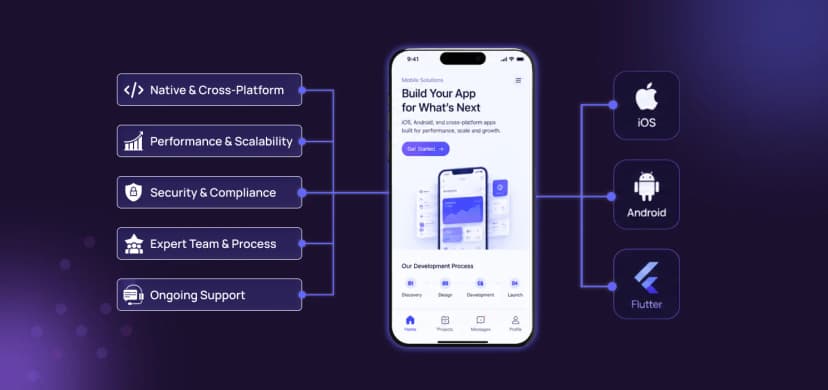
One of the biggest decisions is whether to build native or cross-platform.
Native development uses technologies designed specifically for each operating system.
For example:
iOS → Swift
Android → Kotlin
Native development can be useful when your app needs deep access to platform-specific features or extremely specialised performance.
Frameworks such as Flutter and React Native allow teams to share a significant amount of code between platforms.
This can be useful when you want to launch on both iOS and Android while keeping development more efficient.
Neither approach is automatically better.
The right choice depends on:
A good development partner should explain why a particular approach fits your product.

Design the user experience before writing code
A technically impressive app can still fail if users cannot figure out how to use it.
Before development, map the important user journeys.
For example:
Open app → Sign in → Find service → Select option → Complete action
Then ask:
Can any step be removed?
Is the next action obvious?
Does the user know what happened after completing an action?
Good UX reduces friction.
And reducing friction can directly affect conversions, engagement and retention.

Keep the interface simple
Users should not need instructions for basic actions.
Use consistent:
A design system can help maintain consistency as the app grows.
It also makes future development easier because designers and developers work from the same set of components.

Design for performance from the beginning
Performance should not be treated as something to fix before launch.
Think about it during architecture and development.
Important areas include:
A beautiful app that takes several seconds to respond to simple actions will quickly frustrate users.

Build a reliable backend
The mobile application is only the visible part of the product.
Behind it, you may have:
Mobile app → API → Business logic → Database
The backend may handle:
If the backend is poorly designed, the mobile app can become unreliable as usage increases.
However, scalability does not mean making the architecture unnecessarily complicated from day one.
Build for your expected requirements and leave room for sensible growth.

Use APIs to connect your business systems
Modern mobile apps often need to communicate with other platforms.
For example:
App → CRM
App → ERP
App → Payment gateway
App → Inventory system
App → Customer support platform
APIs allow these systems to exchange information.
Imagine a sales representative updates a customer’s information in the mobile app.
That information can automatically reach the company’s CRM.
The employee saves time.
The business gets more consistent data.
The customer does not have to repeat information.

Treat security as part of development
Mobile apps can handle highly valuable information.
Depending on the application, this might include:
Security should therefore be considered throughout the development process.
Important areas include:
Security should not be a final step before submitting the app to an app store.

Choose authentication based on the product
Different applications need different levels of authentication.
Options can include:
A financial application may require stronger security than a simple content application.
At the same time, adding unnecessary login friction can hurt the user experience.
The right approach balances security and convenience.

Use analytics to understand real users
After launch, assumptions become less important than actual behaviour.
Analytics can help you understand:
For example, 20,000 downloads may sound impressive.
But if only 1,000 people complete the action that matters to your business, downloads are not the most useful metric.
Track the behaviour connected to your actual goal.

Test on real devices
An app that works perfectly on one device may behave differently on another.
Testing should consider:
Automated testing is valuable, but real-device testing is also important.
You want to know how the app behaves in the conditions your users actually experience.

Plan for poor connectivity
Not every user has a fast and stable internet connection.
Depending on your application, consider:
If the connection disappears, the app should explain what happened instead of simply appearing broken.

Plan for continuous improvement
Launching version one is not the end of mobile app development.
After launch, you may need to improve:
You may also discover that users do not use a feature the way you expected.
That is useful information.
A modern app strategy should therefore follow a cycle:
Build → Launch → Measure → Learn → Improve

Common mistakes to avoid

How Code and Core can help
At Code and Core, custom mobile app development services can be planned around your business requirements rather than a fixed technology stack.
The process can include:
The focus is not simply on building an app.
It is on building something that users can understand, businesses can operate and products can improve over time.
A successful mobile app is not created by adding as many features as possible. It starts with a clear problem.
Then you:
Understand the users
Define the MVP
Choose the right technology
Design the experience
Build a reliable backend
Prioritise security
Test properly
Measure real behaviour
Keep improving
That is what makes modern mobile app development different. The technology matters, but it should support the product not become the product.
If you are considering custom mobile app development, start by asking what you want the app to change for your users or your business.
Once that answer is clear, the right technology, features and development strategy become much easier to define.
Code and Core can help turn your idea into a practical mobile product, from UX and MVP planning to development, integrations, testing, and ongoing support.
Have an app idea? Start with the problem, define the value, and build the technology around it.
Catch wind of the latest technologies, strategies, and information that are set to boost your business operation. We update frequently!