Development 03.09.2026
03.09.2026 SpeedyGo: One plugin to make your WordPress website faster
 Corvexa: AI that turn more website visitors into qualified leads.
 Energy
 Oil and gas
 Transportation
 E-commerce
 Healthcare
 Real Estate
 Fintech
 Manufacturing
 Education
 Agriculture
 Travel
 Cyber Security
 Crypto
 Law and Order
 Entertainment
 Hospitality
 Logistics
 Non-profit
 Digital Industry
 Venture Capital
A Quick Guide on the Right Software Development Approach for Enterprises in 2023


 03/09/2026


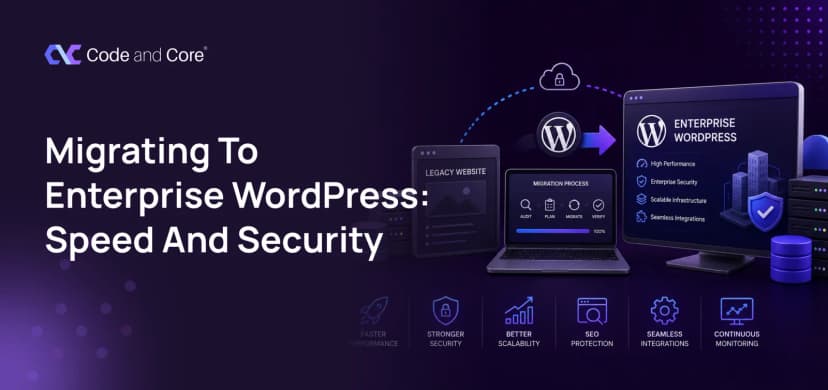
In this guide, we will cover the key things businesses should consider when migrating to enterprise WordPress, including performance, security, SEO, testing, infrastructure and post-launch monitoring.

Why enterprise WordPress migration is different
A small business website might contain a few dozen pages.
An enterprise website could have:
A mistake that affects one page on a small website could affect thousands of URLs on an enterprise platform.
This is why enterprise migration requires planning before development begins.

Start with a complete website audit
Before moving anything, understand what currently exists.
Review:
Create a complete inventory of important content and functionality.
This gives the development team a clear picture of what needs to be migrated and what can be removed.
Large websites often contain years of unnecessary content.
You may find:
Do not automatically migrate everything.
Classify content as:
Keep → Update → Merge → Redirect → Remove
This can make the new WordPress website easier to manage and maintain.

Protect your SEO during migration
SEO is one of the biggest concerns when moving an enterprise website.
Your existing website may have valuable rankings and backlinks that took years to build.
Changing URLs without planning can cause unnecessary traffic loss.
Create a URL mapping strategy
Before launch, map old URLs to their new destinations.

Preserve important SEO elements
During migration, also review:
A successful migration should preserve useful SEO signals while improving the technical foundation.

Performance should be a priority
Enterprise websites need to perform well even when traffic increases.
A migration is an excellent opportunity to remove old performance problems instead of copying them into WordPress.
Review:
Google’s Core Web Vitals measure loading performance, responsiveness and visual stability through metrics including LCP, INP and CLS.
Use these metrics as part of your performance evaluation before and after migration.
Establish a performance baseline
Before migration, record the performance of important pages.
For example:
Then compare these results after migration.
This gives you evidence of whether the new platform is actually performing better.

Build a proper caching strategy
Enterprise WordPress websites may require multiple caching layers.
Depending on the architecture, this could include:
But caching should not be applied blindly.
A blog article may be easy to cache.
A logged-in dashboard, shopping cart or personalised page requires a different approach.
Your caching strategy should reflect how visitors actually use the website.

Optimise the database
Large WordPress websites can have substantial databases.
They may contain:
Migration is an opportunity to review database structure and remove unnecessary data.
However, do not delete information simply because it looks old.
First determine whether the data is still required for:

Don’t forget images and media
Large websites often have enormous media libraries.
Moving every image without optimisation can carry old performance problems into the new platform.
Before migration, review:
Optimising media can make a noticeable difference to page performance.

Security should be part of the migration
Migration can create temporary security risks.
Staging websites, migration scripts, databases and temporary files may contain sensitive information.
Protect them carefully.
Do not leave a development or staging website openly accessible without protection.
Depending on your setup, use:
Enterprise websites often have many users.
Not everyone needs administrator privileges.
Use the principle of least privilege.

Keep WordPress and plugins updated
After migration, make sure WordPress core, plugins and themes are properly maintained.
Outdated software can introduce security and compatibility risks.
Only install plugins that are genuinely needed, and regularly review whether installed plugins are still maintained and required.

Secure custom development
Enterprise WordPress websites often require custom functionality.
Developers should consider security practices such as:
WordPress provides developer guidance around validation, sanitisation and escaping to help developers handle data safely.
Security should be considered during development—not added after launch.

Test before going live
Never treat staging as a quick preview.
Use it to test the actual website experience.
Test:
This is especially important for enterprise websites.
A website may perform perfectly with: 1,000 products
but behave very differently with: 500,000 products
Whenever possible, testing should reflect realistic production conditions.

Create a rollback plan
Even with careful testing, something can go wrong.
Before launch, decide:
A rollback plan gives the team a clear response instead of forcing everyone to make decisions during an incident.

Monitor the website after launch
Migration does not end when the new website goes live.
Monitor:
Pay particular attention to the first few days and weeks.
Check your important user journeys
Do not monitor only traffic.
Check whether customers can still:
Find a product → Add it to cart → Pay
or:
Find a service → Submit a form → Receive confirmation
A website can have normal traffic while important conversion journeys are broken.

Common enterprise migration mistakes

How an enterprise WordPress agency can help
Enterprise migrations involve several disciplines at once:
Strategy
Development
SEO
Performance
Security
QA
Infrastructure
Maintenance
An experienced enterprise WordPress agency can coordinate these areas instead of treating migration as a simple content transfer.
At Code and Core, enterprise WordPress projects can involve custom WordPress development, performance optimisation, integrations, WooCommerce, security, QA and ongoing maintenance.
The goal should be to create a WordPress environment that is:
Fast
Secure
Scalable
Maintainable
Business-focused

Enterprise websites often have thousands of pages, large databases, multiple integrations, customer accounts, complex content structures, and high traffic. This makes planning, testing, and monitoring much more important.
Create a URL mapping strategy, implement appropriate redirects, preserve important metadata, review canonical URLs, maintain internal links, and monitor rankings and organic traffic after launch.
The timeline depends on the website’s size, content volume, integrations, custom functionality, database complexity, and testing requirements. Large enterprise migrations can require extensive planning and phased implementation.
Test forms, logins, search, navigation, payments, checkout, APIs, CRM and ERP integrations, analytics, redirects, mobile responsiveness, and important customer journeys.
Performance can be improved through appropriate caching, CDN configuration, database optimisation, image optimisation, efficient code, and reducing unnecessary JavaScript, CSS, and third-party scripts.
Not necessarily. Existing content should be reviewed and classified as keep, update, merge, redirect, or remove before migration.
Catch wind of the latest technologies, strategies, and information that are set to boost your business operation. We update frequently!