Technologies 31.08.2026
31.08.2026 SpeedyGo: One plugin to make your WordPress website faster
 Corvexa: AI that turn more website visitors into qualified leads.

 Energy
 Oil and gas
 Transportation
 E-commerce
 Healthcare
 Real Estate
 Fintech
 Manufacturing
 Education
 Agriculture
 Travel
 Cyber Security
 Crypto
 Law and Order
 Entertainment
 Hospitality
 Logistics
 Non-profit
 Digital Industry
 Venture Capital
A Quick Guide on the Right Software Development Approach for Enterprises in 2023


 31/08/2026


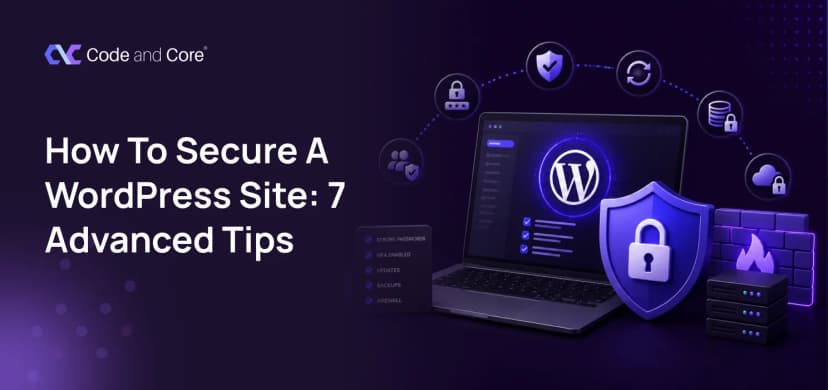
In this guide, you will learn how to secure a WordPress site using seven practical, advanced techniques. We will cover the security settings that are easy to overlook, why administrator accounts need special attention, how to reduce attack surfaces, how to protect WordPress files and databases, and how to build a recovery plan.
The goal is not to make your website impossible to attack—that does not exist.
The goal is to make it harder to compromise, easier to monitor, and much faster to recover if something does go wrong.

Why WordPress security needs more than a plugin
WordPress powers a large part of the web, which makes it an attractive target for automated attacks.
Attackers do not necessarily need to know who owns your website.
Bots can automatically look for:
That means your website can be targeted even if it is a small business website.
Security therefore needs to be considered as a system.
Think of it like protecting an office.
You would not install one lock on the front door and assume everything else is safe.
You would also control:
Who has keys → Which rooms they can enter → How visitors are monitored → Where important documents are stored → What happens if a key is lost
Your WordPress website needs the digital equivalent.

Strengthen authentication and administrator access
Your WordPress administrator account is one of the most important security points.
If an attacker gains administrator access, they may be able to:
So start with the accounts that have the most power.
Every administrator should have a unique password that is not reused anywhere else.
Avoid passwords based on:
A password manager can help generate and store strong credentials.
Multi-factor authentication adds another verification step beyond the password.
For example:
Password + authentication app
If an attacker obtains the password, they still need the additional authentication factor.
For administrator accounts, MFA should be strongly considered.
Review your WordPress users regularly.
If someone no longer needs administrator access, remove or downgrade their permissions.
The principle is simple:
Give users the minimum access they need to do their job.
This is known as the principle of least privilege.

Keep WordPress, plugins and themes updated
One of the most practical WordPress security measures is also one of the easiest to overlook:
Keep everything updated.
That includes:
Updates can contain:
The WordPress security team regularly publishes security releases and recommends keeping WordPress updated to the latest version.
For an important business website, updates should ideally be tested before being applied to production.
A useful workflow is:
Backup → Test → Update → Verify
For larger websites, a staging environment can make this process much safer.

Reduce your attack surface
Every additional component can potentially introduce another security consideration.
That includes:
This does not mean you should stop using plugins.
It means you should avoid unnecessary ones.
Do we actually need this?
Is it actively maintained?
Does the developer provide security updates?
Is it compatible with our WordPress version?
Does it have a good reputation?
Can we achieve the same result without adding another dependency?
If a plugin has not been updated for a long time and is no longer maintained, replacing it may be safer than continuing to depend on it.

Secure file and database access
WordPress depends heavily on files and databases.
If an attacker gains inappropriate access to either, they may be able to modify the website.
Your server should not allow every process or user to modify every file.
File permissions should follow the principle of least privilege.
Only the people and processes that need write access should have it.
The WordPress configuration file contains important database connection information.
It should be protected from public access.
Server configuration should ensure visitors cannot directly download sensitive configuration files.
Your WordPress database credentials should:
The database user should not automatically have unnecessary privileges.

Protect login and admin endpoints
The WordPress login page is a common target for automated attacks.
Attackers can repeatedly attempt passwords against login forms.
Rate limiting can restrict how frequently login or API requests can be made.
For example, a system might limit repeated login attempts from the same source.
This can make automated brute-force attacks more difficult.
Depending on the website, you may also use:
Do not assume that changing the default login URL alone makes a WordPress website secure.
It may reduce some automated noise, but it should not replace proper authentication controls.

Use a Web Application Firewall
A Web Application Firewall, or WAF, sits between users and your website and can inspect incoming traffic.
Depending on the configuration, it can help identify and block suspicious requests.
A WAF may help protect against certain types of malicious traffic, including:
But a WAF is not a substitute for secure code.
Think of it as another security layer.
Your website still needs:
Secure authentication + updated software + safe coding + access control + monitoring

Build backups and a recovery plan
This is the security step many businesses remember only after something goes wrong.
Imagine your website is compromised.
What happens next?
If your answer is:
“We will figure it out.”
you do not have a recovery plan.
Backups should be:
The most important part is often overlooked:
Test your backups.
A backup that has never been restored is not something you should blindly trust.
You should understand:
How quickly can we restore the website?
How much data could we lose?
These questions relate to concepts such as:
For a small brochure website, losing a day’s content may be inconvenient.
For an ecommerce platform processing hundreds of orders, it could be much more serious.

Security monitoring matters
Prevention is important.
But detection is equally important.
You want to know when something unusual happens.
Monitoring can look for:
If something changes unexpectedly, you should be able to investigate quickly.

Use HTTPS correctly
HTTPS encrypts communication between the user’s browser and your website.
This helps protect information while it travels between the visitor and the server.
It is particularly important for:
But simply having an SSL certificate does not make the entire website secure.
HTTPS protects data in transit.
It does not protect you from:
Think of HTTPS as one layer—not the entire security strategy.
File uploads can create significant security risks if they are not handled properly.
For example, an application allowing users to upload files needs to consider:
Do not trust the file extension alone.
A file called:
image.jpg
is not necessarily a safe image.
The application should validate uploads appropriately.

Protect the WordPress REST API
WordPress provides a REST API that allows applications to interact with WordPress programmatically.
This is useful for:
But APIs should expose only the information and actions that are appropriate.
Review:
Do not assume that an API is safe simply because WordPress provides it.

Use secure coding practices
Security is not only a server issue.
Custom WordPress code must also be written securely.
Developers should consider:
WordPress provides developer guidance around data validation, sanitisation and escaping, which should be followed when building custom functionality.
If a visitor submits information through a form, treat it as untrusted.
Validate it.
Sanitise it where appropriate.
Escape output when displaying it.
This is particularly important for custom plugins and themes.

Use user roles correctly
WordPress provides several default user roles, including:
Do not give everyone administrator access simply because it is convenient.
For example:
A content writer may need to publish articles.
They probably do not need permission to install plugins or modify website configuration.
Restrict access based on actual responsibilities.

Protect staging and development environments
Sometimes companies focus heavily on production security and forget about staging websites.
A staging website may contain:
If the staging environment is publicly accessible, it can create unnecessary risk.
Depending on the setup, staging environments may need:
And never assume that hiding a staging URL is sufficient security.

Disable unnecessary features
WordPress and plugins may provide functionality that your website does not need.
Review unnecessary:
Reducing unnecessary functionality can reduce the number of things that need to be secured and maintained.

Be careful with debugging in production
Debugging tools are useful during development.
But exposing detailed error information publicly can reveal technical details that attackers could use.
Production environments should be configured appropriately so that sensitive debugging information is not displayed to visitors.

Dont ignore hosting security
WordPress security does not stop at WordPress.
Your hosting environment matters too.
A secure setup can include:
If your WordPress website is running on poorly configured infrastructure, even excellent WordPress practices may not be enough.

Security headers can add another layer
HTTP security headers can help browsers handle your website more securely.
Depending on the application, useful headers can include:
These should be configured carefully.
For example, an overly restrictive Content Security Policy can break legitimate scripts and functionality.
Security configuration should therefore be tested rather than copied blindly.

What should you do if your WordPress website is hacked
If you suspect a compromise, do not simply reinstall WordPress and hope for the best.
Start by containing the problem.
Look for:
Depending on the incident, temporarily limiting access can prevent further damage.
Logs and changed files can help identify what happened.
Possible causes include:
Do not simply delete the obvious suspicious file.
Attackers may have created multiple persistence mechanisms.
Change affected:
If you have reliable backups, restoration may be appropriate.
Otherwise, the website may simply become compromised again.

What not to do when securing WordPress
Avoid relying on one “magic” solution.
Security plugins can be useful.
But they cannot fix:
Multiple plugins may conflict and create unnecessary complexity.
An inactive or abandoned plugin can become a security risk.
More privileges mean greater consequences if an account is compromised.
Security is also about recovery.

How Code and Core can help secure WordPress websites
At Code and Core, WordPress development can include security as part of the wider development and maintenance process rather than treating it as an isolated task.
Depending on the project, the team can work across:
The right approach depends on the website.
A simple corporate website may require a very different security strategy from a WooCommerce store, membership platform or customer portal.
The important thing is to understand the actual risks before adding tools.
Catch wind of the latest technologies, strategies, and information that are set to boost your business operation. We update frequently!