Technologies 26.08.2026
26.08.2026 SpeedyGo: One plugin to make your WordPress website faster
 Corvexa: AI that turn more website visitors into qualified leads.

 Energy
 Oil and gas
 Transportation
 E-commerce
 Healthcare
 Real Estate
 Fintech
 Manufacturing
 Education
 Agriculture
 Travel
 Cyber Security
 Crypto
 Law and Order
 Entertainment
 Hospitality
 Logistics
 Non-profit
 Digital Industry
 Venture Capital
A Quick Guide on the Right Software Development Approach for Enterprises in 2023


 26/08/2026


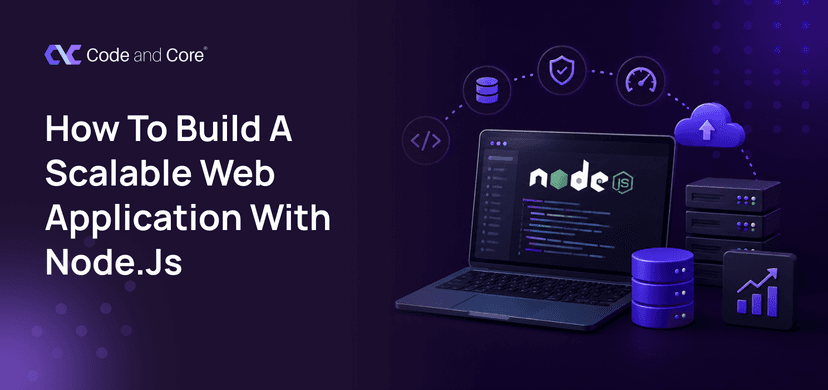
In this guide, we will break down how to build a scalable web application with Node.js, including architecture, databases, APIs, caching, authentication, performance, security, testing, monitoring, deployment, and common mistakes. You will also learn when Node.js makes sense, when it may not, and how custom web software development can help businesses build applications around their actual requirements.
The goal is not to build the most complicated application possible. It is to build a system that can grow without becoming unnecessarily difficult or expensive to maintain.

What does scalability mean in web application development
Scalability is the ability of an application to handle increasing demand without a major drop in performance or reliability.
That demand could come from:
Imagine your application starts with 500 users. A year later, it has 50,000.
If the original architecture was designed only for the first 500 users, you may start seeing:
Scalability is about preparing the application to handle growth more effectively.

Why use Nodejs for scalable web applications
Node.js is a JavaScript runtime built on Chrome’s V8 JavaScript engine. It is designed around an event-driven, non-blocking I/O model, which makes it particularly useful for applications that handle many concurrent network operations.
This makes Node.js a popular choice for:
One of its practical advantages is that teams can use JavaScript or TypeScript across both frontend and backend. But Node.js is not automatically scalable.
Architecture matters more than simply choosing Node.js.

Nodejs scalability starts with architecture
Before writing code, decide how the application should be structured.
A basic application might look like: User → Frontend → Node.js server → Database
As the application grows, the architecture may become:
Users
↓
Load balancer
↓
Multiple application servers
↓
Caching layer + Database + Storage + External services
The goal is to avoid having one component become a single bottleneck.

Start with a clear application architecture
There is no single architecture that works for every project.
The right approach depends on:
For many applications, a well-structured modular monolith can be a better starting point than immediately creating dozens of microservices.
What is a modular monolith?
A modular monolith is a single deployable application that is internally divided into well-defined modules.
For example:
Users
Payments
Orders
Notifications
Reports
Authentication
Each module has its own responsibilities. This can keep development simpler while making future separation possible if the application eventually requires it.

When should you consider microservices
Microservices divide an application into independently deployable services.
For example:
User Service
Payment Service
Order Service
Notification Service
This can provide advantages when different parts of the system need to scale or deploy independently. But microservices also introduce complexity.
You now have to manage:
So do not choose microservices simply because they sound more scalable. A well-designed monolith can scale very effectively.

Design APIs carefully
APIs are the communication layer between different parts of your system. A scalable Node.js application should have predictable APIs.
For example:
GET /api/products
GET /api/products/:id
POST /api/products
PUT /api/products/:id
DELETE /api/products/:id
Good API design makes applications easier to:
Keep API responses efficient
Do not return unnecessary information.
If the frontend only needs:
id
name
price
there is little reason to return an enormous object containing every field.
Smaller responses can reduce:

Choose the database carefully
Your Node.js application is only as scalable as the system storing its data.
Common choices include:
The best choice depends on your data and application requirements.
PostgreSQL and MySQL are useful when your application relies heavily on structured relationships and transactions.
For example: Customer → Orders → Products → Payments
MongoDB can be useful for applications where flexible document-oriented data structures are appropriate.
Redis is commonly used for:
The important thing is not choosing the database that is most popular. It is choosing the database that fits your application’s data model.

Database indexing matters
A database query can be fast with 10,000 records and painfully slow with 10 million. Indexes help databases find information more efficiently. For example, if users frequently search by email address, an index on the email field can improve lookup performance. But indexes also have a cost. Too many indexes can increase storage and slow down write operations. So indexing should be based on actual query patterns.

Avoid unnecessary database queries
One common scalability problem is making too many database requests.
Imagine a page that loads:
If every component independently requests data, the application can generate a large number of database operations.
Instead, think about: What data does this page actually need?
Then design efficient queries and API responses around that requirement.

Add caching strategically
Caching means storing frequently requested data somewhere faster so the application does not have to generate it repeatedly.
For example: User → Request → Cache → Response
If the information is already available in the cache, the application may not need to query the database.
What can be cached?
Depending on the application:
Redis is commonly used for application-level caching. But caching should not be added randomly.
You need to understand:
What can be cached?
How long should it remain valid?
When should it be invalidated?
Bad cache invalidation can create outdated or incorrect information.

Use asynchronous processing for heavy tasks
Not everything needs to happen during the user’s request.
Suppose a user uploads a large file.
The application could: Upload → Save request → Background processing → Notify user
instead of keeping the user waiting while everything happens synchronously.
Background jobs can handle tasks such as:
Queue systems can help manage these jobs.

Use load balancing
When one server is handling all requests, it eventually becomes a bottleneck. A load balancer can distribute traffic across multiple application instances.
For example:
Users
↓
Load balancer
↓Node.js instance 1
Node.js instance 2
Node.js instance 3
If one instance becomes unavailable, traffic can potentially be redirected to another healthy instance. This improves both scalability and resilience.
A stateless application does not depend on one specific server remembering a user’s session. This makes horizontal scaling easier.
Instead of: User → Always Server A
you can have: User → Load Balancer → Server A/B/C
Authentication tokens, shared session storage, or other appropriate mechanisms can help maintain user state without tying the user to one server.

Handle authentication properly
Authentication is one of the most important parts of a web application.
Depending on the application, you may use:
Authentication should be designed alongside the rest of the architecture. Do not treat it as something that can simply be added at the end.
Scalability without security is not useful.
A production application should consider:
The Open Worldwide Application Security Project (OWASP) maintains widely used guidance for web application security, including its OWASP Top 10 risks. Security should be part of architecture rather than a last-minute checklist.

Rate limiting
Imagine someone sends thousands of requests to your API within a few seconds. Without protection, legitimate users may experience slower performance or the system could become overloaded. Rate limiting controls how frequently clients can make requests.
For example: 100 requests per minute per user
The exact limit depends on the application. Different endpoints may need different limits.

Optimise the frontend too
Backend scalability does not solve every performance problem. Your frontend also matters.
Consider:
A fast Node.js backend cannot compensate for a frontend that sends massive JavaScript bundles to every visitor.

Use a CDN for static content
A Content Delivery Network can distribute static assets across locations closer to users.
Static assets can include:
This can reduce the distance between users and the files they need. For applications serving users across different countries, a CDN can become particularly useful.

Design for observability
You cannot fix a performance problem if you do not know it exists.
A scalable application should provide visibility into:
Logging: Logs help developers understand what happened.
Monitoring: Monitoring helps identify when something is going wrong.
Alerts: Alerts notify the team when a defined threshold is reached.
Together, these provide the visibility needed to operate a production application.

Test before you scale
You do not need to wait for real users to discover the limits of your application.
Load testing can simulate traffic and help answer questions such as:
The goal is not to guess scalability. It is to measure it.

Use automated testing
Testing should happen throughout development.
Depending on the project, this can include:
Automated tests become particularly valuable as applications become larger. When developers add new features, existing functionality should continue working.
Continuous integration and continuous delivery can automate parts of the development and deployment process.
A typical workflow could look like:
Developer commits code
↓
Automated tests
↓
Build
↓
Security checks
↓
Deployment
↓
Monitoring
This reduces manual errors and makes releases more predictable.

Scale horizontally before simply buying a bigger server
There are two basic ways to scale.
Give one server more:
Add more application instances.
For example: 1 server → 2 servers → 5 servers
Horizontal scaling can provide more flexibility as traffic grows, particularly when the application is designed to run across multiple instances. But it requires architecture that supports distributed operation.

Plan for database scalability
As data grows, the database may become one of your biggest bottlenecks.
Potential strategies include:
You do not need all of these from the beginning. But you should understand where the database could become a limitation.

Avoid premature optimisation
This is one of the most important lessons in scalable development.
You do not need to optimise everything before you have users.
Instead: Build correctly → Measure → Identify bottlenecks → Optimise
If a database query takes 20 milliseconds, spending weeks trying to reduce it to 5 milliseconds may not provide meaningful business value. But if a query takes three seconds and runs thousands of times per minute, optimisation becomes important. Use data to decide.

How Code and Core can approach scalable web applications
How Code and Core can approach scalable web applications
At Code and Core, custom web software development can combine business analysis, UX/UI design, frontend development, backend development, integrations, testing, performance optimisation and ongoing maintenance.
Node.js can be used where its event-driven architecture and ecosystem make sense for the project.
The wider technology stack can also include React, Next.js, PHP, Laravel, Python, MySQL, MongoDB and AWS, depending on the application’s requirements.
The focus should not be: “Let’s use Node.js because it is popular.”
It should be: “What architecture and technology will give this product the right foundation for its users and future growth?”
Building a scalable web application with Node.js starts with the right foundation not simply adding more servers. Focus on modular architecture, database design, APIs, caching, security, testing, monitoring, and performance.
Start with what your business needs today, but make smart choices for tomorrow. Keep the system modular, measure performance, identify bottlenecks, and scale when needed.
The goal is not to build the biggest system possible. It is to build a system that can grow without limiting your business.
Code and Core can help you plan, design, and develop a scalable web application built around your business needs.
Have an application idea? Let’s turn it into a scalable digital product.
Catch wind of the latest technologies, strategies, and information that are set to boost your business operation. We update frequently!
 23.06.2026